I had an interesting exchange today with a relative. (I won't name him because I don't have his permission to do so.) It went like this:
ME: I hesitate to say I'm "left-of-center"--it depends on the issue. I range all over the spectrum, probably because the spectrum itself is all messed up. (I like to think Joseph Smith would have been similarly hard to categorize politically.) But I like the saying: "The heart is a little to the left of center."
HIM: Nice quote. I wish sometimes that right of center were not painted as heartless. It really is unfair in my opinion because the most compassionate people I know are right of center. I've always pictured Joseph smith as being right of center in a world where gay "marriage", outrageous taxation and record deficits, and unfettered access to abortion for convenience is the primary foundation of the party currently in power.
ME: The most compassionate people: I know plenty on both sides of the spectrum. The least compassionate tend toward the extreme on either end.
In response . . . (while partly agreeing and simultaneously strongly challenging the "primary foundation" phrase) I'd add: On the other hand, Joseph's championing of moderate abolitionism, economic egalitarianism (D&C 78:6), racial and religious tolerance, civil rights (with federal protection) for minority groups, and compassionate prison reform would have been considered "liberal" in his own time and would generally be so considered even now.
Attempting a fair assessment (& considering economic issues, foreign affairs, & civil rights, along with hot-button "social issues"), I would put Joseph Smith where I've placed "JS" in the following spectra:
His own time: LLJSLLLRRRRRRR
Our time: LLLLLJSRRRRRRR
But a linear spectrum is far too simplistic to capture anyone's political views.
HIM: Bruce, I agree, the linear spectrum is far too simplistic. The best model is not really a "spectrum" at all, but a 3D or even 4D (includes time) representation of some kind.
As for the primary foundation phrase, I have to stand by it. Until I see the "left" reform itself on those issues as much as they seem to require of the "right" on our alleged inadequate treatment of our fellow man, they will remain, in my mind, very far removed from any sort of monopoly on compassion. It is not compassion to condone or promote physical abuse of a child in the world nor in the womb. There is simply no way to justify it. None at all. I feel very strongly about this, as you can tell. It's a very personal issue for me, but then all issues are personal to the ones who hold strong opinions about them. Otherwise, they wouldn't care enough to vote about them. All voters are single-issue voters because in the end, you have to stand your ground on one major thing to check "yes" or "no" on a ballot."
[end of exchange]
************************************
Joseph Smith (for those who don't know) was the first president and prophet of The Church of Jesus Christ of Latter-day Saints. He ran for president in 1844, and though some think he did so with no serious thought of winning, but rather to help protect the rights of Latter-day Saints and to help promote the Church's religious views, he had a platform that dealt seriously with the issues of the day, for instance, proposing a plan to end slavery.
I stand by my view that his "championing of moderate abolitionism, economic egalitarianism (D&C 78:6), racial and religious tolerance, civil rights (with federal protection) for minority groups, and compassionate prison reform would have been considered 'liberal' in his own time and would generally be so considered even now." But I acknowledge that the whole matter is far from simple. At some point, I'll post something on where I think Joseph Smith, the Church (historically and at present), and the gospel might fit on the political spectrum on various issues. And of course, I'll give my reasons and evidence.
To expand a bit on the views I expressed above, I'll take two issues in order:
1. Most compassionate, least compassionate: I haven't found, in real life situations, that compassion correlates particularly well with political views. I know some exceptionally good, compassionate people on both sides of the political spectrum. Sometimes, views on a particular issue have something to do with practical acts of compassion. Some conservatives care deeply about preventing the destruction of unborn children (aka abortion), about caring for the aged and disabled, and about promoting non-governmental--and sometimes governmental--efforts to help those in need. (Orrin Hatch, for instance, has worked with Teddy Kennedy and others in promoting some government initiatives he feels are effective and needed.)
Some liberals, on the other hand, are prompted by their ideals to promote efforts to help the needy and underprivileged, often through government programs but also in personal and private ways. Some I would call "liberal" (including at least one Church General Authority I happen to know) fit that label partly because of their concern about extending tolerance, sensitivity, and concern to those who are different, who don't "fit in." And "liberals" tend to be more compassionate on foreign policy and immigration issues.
On the other hand, some of these issues are the very ones that make it hard to categorize people. Orrin Hatch is considered very conservative but is selectively liberal, depending on the issue. Harry Reid is considered liberal but is anti-abortion. Governor John Huntsman is a moderate conservative who has taken moderately liberal views on some issues. Two "conservative" leaders in Utah (one a former congressman, the other a former head of the state Republic party) take a moderate, compassionate view on immigration and the treatment of illegal aliens--a view they consider endorsed by LDS Church leaders (I'd agree, having been in meetings where such views have been expressed). These same leaders I've called "conservative" have expressed frustration at what they consider the uncompassionate and unreasonable views of some of their fellow "conservatives" and have been vilified by these same fellow "conservatives" for being too "liberal" on the issue.
I've often noticed how intolerant and mean-spirited some "liberals" can be, especially in their view of people they consider narrow and intolerant. (This is one of the great ironies--but it makes sense in a way if you think about it. It's sort of how some sibling or conjugal arguments go--both sides accuse the other of the same thing, and the accusations themselves are a big part of the evidence.)
I've also known "conservatives" whose have views on some issues that I find horrifying but who have been wonderfully loving in face-to-face relationships. Their "lack of compassion" is largely imaginary--that is, it's directed toward people they don't know, such as the people of different faiths, nationalities, or political views they despise or look down on. But even though such antagonism is in a way imaginary, it does have real-life consequences. People who mentally dehumanize and demonize groups of "enemies" can provide practical toleration or support for treatment of other human beings that has traditionally(by the great religious traditions and by American constitutional traditions) been considered horribly evil, such as torture and indefinite imprisonment without charges or legal representation.
Sometimes political views affect face-to-face relationships as well. Maybe because there are more intense "right wingers" where I live than intense "left wingers," I've found some of the least compassionate people I've know to be extreme conservatives. I'm not at liberty to say all I know, but I have seen the passion that fuels political enthusiasm fueling at the same time intense hatred toward neighbors.
It seems to me the moral virtues should come first: kindness, sensitivity, tolerance, compassion, fairness, integrity, civility, humility. Once those are there, one may find one's place just about anywhere on the political spectrum. But in practice, I think it's likely that in general, and on most issues, one's position will not tend to be either extremely conservative or extremely liberal. There's probably a reason that's so, even given the fact that what counts as "conservative" and "liberal" changes somewhat from generation to generation.
2. Are "gay 'marriage,' outrageous taxation and record deficits, and unfettered access to abortion for convenience" the "primary foundation" of the present-day Democratic party? I don't believe they are.
(a) Gay marriage: A complicated issue--but I believe I can make a strong case that it makes sense to define "marriage" as it has been traditionally understood (which, among other things, means that it is a bond between a man and a woman). I also accept the LDS Church's position on the issue, which is multifaceted but which includes a similar understanding of marriage.
On the other hand, I accept some of the arguments in favor of giving legal status to "civil unions."
The present question, though, is whether support of "gay marriage" is part of the "primary foundation" of the Democratic party. It's probably true that self-identified Democrats are more likely to support gay marriage than self-identified Republicans. But the national platform of the Democratic party does not favor gay marriage; neither President Obama nor Vice President Biden supported it during the presidential campaign (in fact, all four major party candidates said more or less the same thing on the issue); and gay marriage is not favored by Harry Reid and many other Democratic leaders. I know that there are some within the party that are pushing strongly for a pro-"gay marriage" view--and that makes me nervous for a variety of reasons, including the effect it could have on the party as well as the country. But there's no way it makes any sense to call "gay marriage" part of the "primary foundation" of the Democratic party. The answer to that question is simple--fairness, honesty, and intellectual acuity all require "no, it isn't" as the basic answer to this one.
(b) "Outrageous taxation and record deficits": Hmmm. The Democratic party has long been accused of being the party of "spending and taxing." But the facts have been more complicated. Nowadays especially, fairness would require noting a few things: (1) George W. Bush has so far--in the entire history of the United States-- presided over the greatest record spending and deficits; the spending is in part the result of the Iraq invasion; the deficits are partly the result of tax cuts that were supposed to help the economy (reviews are mixed on that) but that many consider to be unfair. (2) Obama has been in office a few months and has proposed minor adjustments in tax rates for the wealthiest Americans (the changes are small enough some would consider them nominal; they are certainly not "outrageous"); deficits continue to climb, partly because of the greatest economic crisis since the Great Depression, a crisis that did not happen under Obama's watch. (3) Obama has declared his intention and has proposed specific plans to decrease the deficit and to move toward getting the massive discrepancy between government income and spending under control; in my opinion, his plans and efforts in this direction are entirely sincere. (For some idea of what he's up to, see http://www.msnbc.msn.com/id/29868186/ .)
I believe it's entirely legitimate to disagree with Obama's approach. I'm not sure anyone really knows enough or has been granted the ability to foresee the economic future in such detail that they would know exactly how best to tackle the current crisis. But I trust Obama's efforts as ones based at least on some solid principles I believe in and on the wisest advice he's been able to gather. He certainly has no desire to create a system in which what most people would consider "outrageous taxation and record deficits" are the norm.
(c) "Unfettered access to abortion for convenience": The position that many in the Democratic party have had on abortion has been one of the saddest and most challenging features of political life for me over the past 20 or 30 years. The party has, however, become more open on the issue, accommodating those with "pro-life" as well as "pro-choice" views. ("Pro-lifers" include, for instance, Harry Reid and Bob Casey.)
My own views--and the LDS Church's, for that matter--are not, however, on what is usually considered the extreme conservative side on this issue. For years, in fact, some of the anti-Mormon protesters who carry banners outside of the LDS General Conference meetings have criticized the Church for not being anti-abortion enough. The reality is that the Church's position includes elements of "pro-life" and "pro-choice"--the "choice" part being that, even in cases where the Church permits members to retain good standing for participating in abortions, encouragement is given to make the choice carefully and prayerfully.
I would like to see, as a beginning step, the removal of public funding for elective abortions. (That's Joe Biden's position.) I'd like to greatly limit what are called "partial birth" (i.e., late term) abortions--but I think it's appropriate for the law in these cases to allow exceptions for serious threats to a mother's life and health. Beyond those two things, I would focus more on education and persuasion--helping people feel, see, and live differently no matter what the law says they can and can't do--and dealing with adoption, the plight of single mothers, problems of sexual exploitation, etc., etc., which (I'm told by people who work with these issues) are often at the root of the choice to abort a child.
For more on the abortion issue as I view it, see http://bruceyoung-whyobama.blogspot.com/2008/10/abortion-my-views-candidates-views.html .
A quick summary of President Obama's view: He believes abortion is a "tragic situation" but calls himself "pro-choice" and believes that "ultimately . . . women in consultation with their families, their doctors, their religious advisers, are in the best position to make this decision." He opposes late-term abortions as long as exceptions are made for threats to the mother's life or health. He favors various measure to discourage abortion including encouraging sexual responsibility ("sexuality is sacred") and adoption and making it more economically feasible for women to choose to give birth rather than have an abortion. (For more on his views, see the link noted above and also http://www.clipsandcomment.com/2008/10/15/transcript-third-and-final-presidential-debate-barack-obama-%E2%80%93-john-mccain-hofstra-university-october-15-2008/--the source of the quotations.)
At some point, I'd also like to write a blog post titled "Why Mormons should support Obama," explaining that that doesn't necessarily mean agreeing with or even voting for him. It will be a good one, once I get around to it . . .
Monday, May 11, 2009

TWILIGHT: The short version
My wife Margaret got this from a friend who got it from a friend; I'm told it was created by Eric Snider (see http://www.ericdsnider.com/snide/my-rejected-twilight-screenplay/ ):
Scene 1
BELLA: I'm sad to leave the horrible, uninhabitable wasteland of Phoenix to live in a rain-soaked town full of country people that do not understand my city ways. I wish everything about my comfortable and privileged life were completely different!
DAD: Hi, Bella! Welcome to Forks, Washington. I'm glad you've stopped playing mother to your own flighty, irresponsible mom and come here to be my mother instead.
BELLA: It will be my pleasure to cook and clean for you.
DAD: I bought you an old truck from an Indian in a wheelchair!
BELLA: I ... have no response for that.
* * * * *
Scene 2
BELLA: It's tough being the new kid in school! Especially when everyone is so friendly and helpful and interested in me. Why can't they just leave me alone so I can sit in the corner and be left alone to pout?
CLASSMATE: You're awesome, Bella!
BELLA: See what I have to put up with? Hey -- who are those hot people over there?
CLASSMATE: Those are the Cullens. They avoid direct sunlight, they don't eat food, they sleep in coffins in a graveyard, and holy water burns them. I think they're Canadians.
BELLA: They sure are spectacularly gorgeous.
CLASSMATE: Yes, they are.
BELLA: I mean seriously, those people are BEAUTIFUL. Especially the one who keeps looking at me. Man alive, that guy is stunning. I mean, wow. He is hot buttered seduction on a stick. I mean, LOOK AT HIM! If you don't mind, I'd like to spend the next 75 pages talking exclusively about how attractive he is, and then bring it up again every paragraph or so for the remaining 400 pages.
CLASSMATE: Knock yourself out.
* * * * *
Scene 3
EDWARD: Hi, I'm Edward. I'm every girl's fantasy boyfriend: moody, humorless, violent, capable of snapping your spine with my bare hands, liable to do creepy things like watch you while you're sleeping, but also really cute.
BELLA: There is something strange about you.
EDWARD: (recoils at her garlic breathe) I don't know what you mean.
BELLA: I just can't put my finger on what it is.
EDWARD: (lifts automobile with one hand) You're imagining things.
BELLA: I feel like you're hiding something from me.
EDWARD: (grabs passing rabbit with lightning speed; drinks rabbit's blood) Don't be silly!
BELLA: It's like you're different somehow.
EDWARD: (turns into bat; flies away)
BELLA: Hmm. I bet he's foreign.
* * * * *
Scene 4
JACOB: You should be careful with those Cullens. Many moons ago, our tribe's elders, who were werewolves, made a pact with the Cullens, who were vampires. They're not allowed on our land, not even at our casinos.
BELLA: What, still? Even after all this time has passed?
JACOB: Nope.
BELLA: Since when do white people honor treaties with Indians?
JACOB: I know, right?
BELLA: Let me guess -- you're a character whose only job is to provide exposition, and you won't be useful until the next book.
JACOB: Yes. At the earliest.
* * * * *
Scene 5
BELLA: Thanks for saving me from that mob of guys who attacked me in the street! It's a good thing you obsessively stalk me while simultaneously insisting you want nothing to do with me.
EDWARD: No problem. If anyone's going to tear you limb from limb and gorge them selves on your sweet, delicious, life-giving blood, it's going to be me.
BELLA: Aw, you say the nicest things! I'm pretty sure you're a vampire, that I'm in love with you, and that part of you wants to kill me.
EDWARD: Don't be silly. It's not just part of me.
BELLA: HA HA HA!!! You're so funny!
* * * * *
Scene 6
EDWARD: You know what vampires love? Baseball!
BELLA: Really?
EDWARD: Sure! Haven't you ever heard of vampire bats?
>Crickets<
EDWARD: Anyhoo, these are the vampire friends I live with, the Cullens. They've been very eager to eat you.
BELLA: You mean meet me?
EDWARD: Meet you. What did I say?
ALICE: I'm Alice! I can see the future, but only when it's useful to the plot. For example, right now: Look out for those mean vampires barging in from the forest!
MEAN VAMPIRE JAMES: Fe-Fi-Fo-Fum! I smell the blood of a human!
EDWARD: Stay away from her! Bella, you'd better go. I don't want you to have to see me fight this guy for your honor, our muscles straining as we grapple, the air thick with testosterone and the sounds of our throaty snarling.
BELLA: Right! I wouldn't want to see that! Especially not if your shirts got torn off!
* * * * *
Scene 7
MEAN VAMPIRE JAMES: You puny humans are so predictable and weak. Now I've got you alone, free to toy with you and torture you and deliver lengthy explanatory monologues to you! I just hope I don't waste so much time that when I finally do decide to kill you it's too late because Edward and the Cullens have arrived to save you!
BELLA: That would certainly be an unusual twist!
MEAN VAMPIRE JAMES: Never mind! At last it is time for me to--
EDWARD: Not so fast, Count Jerkula!
MEAN VAMPIRE JAMES: Edward! And the Cullens! Who could have foreseen your perfectly timed arrival?!
ALICE: I could have! Didn't, but could have!
(Fighting ensues. MEAN VAMPIRE JAMES is vanquished.)
EDWARD: Bella! Are you OK? He bit you! I've got to suck out the vampire poison!
BELLA: Edward, you don't have to make up excuses to suck my blood. I mean honestly, who ever heard of "vampire poison"?
EDWARD: I'm serious! It's coursing through your veins as we speak!
BELLA: Uh-huh, Whatever you say.
* * * * *
Scene 8
BELLA: Why did you bring me to the prom, Edward? You know I can't dance, and that I hate it when people tell me I'm beautiful, which happens all the time.
EDWARD: I don't want your dangerous psychological infatuation with a vampire to interfere with your regular life.
BELLA: But I want to BE a vampire! I want you to do it to me.
EDWARD: You're sure you want to be a vampire?
BELLA: Yes.
EDWARD: Well, how about if I press my lips against your throat in an ambiguous way, just enough to ensure that readers come back for the sequel?
BELLA: It's a deal.
(Fade to black; roll credits; send in ushers to mop up audience's tears and drool.)
Scene 1
BELLA: I'm sad to leave the horrible, uninhabitable wasteland of Phoenix to live in a rain-soaked town full of country people that do not understand my city ways. I wish everything about my comfortable and privileged life were completely different!
DAD: Hi, Bella! Welcome to Forks, Washington. I'm glad you've stopped playing mother to your own flighty, irresponsible mom and come here to be my mother instead.
BELLA: It will be my pleasure to cook and clean for you.
DAD: I bought you an old truck from an Indian in a wheelchair!
BELLA: I ... have no response for that.
* * * * *
Scene 2
BELLA: It's tough being the new kid in school! Especially when everyone is so friendly and helpful and interested in me. Why can't they just leave me alone so I can sit in the corner and be left alone to pout?
CLASSMATE: You're awesome, Bella!
BELLA: See what I have to put up with? Hey -- who are those hot people over there?
CLASSMATE: Those are the Cullens. They avoid direct sunlight, they don't eat food, they sleep in coffins in a graveyard, and holy water burns them. I think they're Canadians.
BELLA: They sure are spectacularly gorgeous.
CLASSMATE: Yes, they are.
BELLA: I mean seriously, those people are BEAUTIFUL. Especially the one who keeps looking at me. Man alive, that guy is stunning. I mean, wow. He is hot buttered seduction on a stick. I mean, LOOK AT HIM! If you don't mind, I'd like to spend the next 75 pages talking exclusively about how attractive he is, and then bring it up again every paragraph or so for the remaining 400 pages.
CLASSMATE: Knock yourself out.
* * * * *
Scene 3
EDWARD: Hi, I'm Edward. I'm every girl's fantasy boyfriend: moody, humorless, violent, capable of snapping your spine with my bare hands, liable to do creepy things like watch you while you're sleeping, but also really cute.
BELLA: There is something strange about you.
EDWARD: (recoils at her garlic breathe) I don't know what you mean.
BELLA: I just can't put my finger on what it is.
EDWARD: (lifts automobile with one hand) You're imagining things.
BELLA: I feel like you're hiding something from me.
EDWARD: (grabs passing rabbit with lightning speed; drinks rabbit's blood) Don't be silly!
BELLA: It's like you're different somehow.
EDWARD: (turns into bat; flies away)
BELLA: Hmm. I bet he's foreign.
* * * * *
Scene 4
JACOB: You should be careful with those Cullens. Many moons ago, our tribe's elders, who were werewolves, made a pact with the Cullens, who were vampires. They're not allowed on our land, not even at our casinos.
BELLA: What, still? Even after all this time has passed?
JACOB: Nope.
BELLA: Since when do white people honor treaties with Indians?
JACOB: I know, right?
BELLA: Let me guess -- you're a character whose only job is to provide exposition, and you won't be useful until the next book.
JACOB: Yes. At the earliest.
* * * * *
Scene 5
BELLA: Thanks for saving me from that mob of guys who attacked me in the street! It's a good thing you obsessively stalk me while simultaneously insisting you want nothing to do with me.
EDWARD: No problem. If anyone's going to tear you limb from limb and gorge them selves on your sweet, delicious, life-giving blood, it's going to be me.
BELLA: Aw, you say the nicest things! I'm pretty sure you're a vampire, that I'm in love with you, and that part of you wants to kill me.
EDWARD: Don't be silly. It's not just part of me.
BELLA: HA HA HA!!! You're so funny!
* * * * *
Scene 6
EDWARD: You know what vampires love? Baseball!
BELLA: Really?
EDWARD: Sure! Haven't you ever heard of vampire bats?
>Crickets<
EDWARD: Anyhoo, these are the vampire friends I live with, the Cullens. They've been very eager to eat you.
BELLA: You mean meet me?
EDWARD: Meet you. What did I say?
ALICE: I'm Alice! I can see the future, but only when it's useful to the plot. For example, right now: Look out for those mean vampires barging in from the forest!
MEAN VAMPIRE JAMES: Fe-Fi-Fo-Fum! I smell the blood of a human!
EDWARD: Stay away from her! Bella, you'd better go. I don't want you to have to see me fight this guy for your honor, our muscles straining as we grapple, the air thick with testosterone and the sounds of our throaty snarling.
BELLA: Right! I wouldn't want to see that! Especially not if your shirts got torn off!
* * * * *
Scene 7
MEAN VAMPIRE JAMES: You puny humans are so predictable and weak. Now I've got you alone, free to toy with you and torture you and deliver lengthy explanatory monologues to you! I just hope I don't waste so much time that when I finally do decide to kill you it's too late because Edward and the Cullens have arrived to save you!
BELLA: That would certainly be an unusual twist!
MEAN VAMPIRE JAMES: Never mind! At last it is time for me to--
EDWARD: Not so fast, Count Jerkula!
MEAN VAMPIRE JAMES: Edward! And the Cullens! Who could have foreseen your perfectly timed arrival?!
ALICE: I could have! Didn't, but could have!
(Fighting ensues. MEAN VAMPIRE JAMES is vanquished.)
EDWARD: Bella! Are you OK? He bit you! I've got to suck out the vampire poison!
BELLA: Edward, you don't have to make up excuses to suck my blood. I mean honestly, who ever heard of "vampire poison"?
EDWARD: I'm serious! It's coursing through your veins as we speak!
BELLA: Uh-huh, Whatever you say.
* * * * *
Scene 8
BELLA: Why did you bring me to the prom, Edward? You know I can't dance, and that I hate it when people tell me I'm beautiful, which happens all the time.
EDWARD: I don't want your dangerous psychological infatuation with a vampire to interfere with your regular life.
BELLA: But I want to BE a vampire! I want you to do it to me.
EDWARD: You're sure you want to be a vampire?
BELLA: Yes.
EDWARD: Well, how about if I press my lips against your throat in an ambiguous way, just enough to ensure that readers come back for the sequel?
BELLA: It's a deal.
(Fade to black; roll credits; send in ushers to mop up audience's tears and drool.)
Tuesday, April 7, 2009
Lynda Young Tuckett: on the first anniversary of her death
My sister Lynda Young Tuckett died a year ago today. In her memory, I copy here the tenderly, beautifully expressed feelings of her husband, Joe Tuckett, as found in the obituary he wrote at the time of her death:
On Monday, April 7, 2008, our loving wife, mother, daughter, sister, and dear friend lost her ten year battle with breast cancer, the past two years being painful bone cancer. She is now free from her pain and the cares of the world. For this we are grateful.
Lynda was born September 28, 1962 in Payson, Utah. She was born to goodly parents, Daren C. and Ruth W. Young, and was blessed to have been born into a wonderful, loving family with five siblings. She resided most of her life in Spanish Fork. Lynda met her sweetheart at a Single Adult dance and knew that they would be eternal companions after this first chance meeting. She was married on June 26, 1981 in the Salt Lake Temple to Joseph Steven Tuckett. After living one year in Spanish Fork, they purchased a home in Payson and resided there until her death. Together they raised three beautiful children. The oldest is Steven, then Angeline, then her baby, Aubriana.
Lynda graduated from Spanish Fork High School and attended UVSC for a short time until her marriage. She was a very intelligent person although, in her modesty, she didn't feel that she was.
Lynda served the Lord diligently, always going the extra mile, in every calling that she received. She served in the Primary, Cub Scouts, Young Women, and the Relief Society. She also served the Lord well by being a good neighbor and friend to those around her. Often, she would send notes to someone after they had given a touching talk or lesson in church...or to a stranger who she felt needed a little encouragement or to be lifted up in some small way.
Lynda worked for many years as a Title One Technician for Nebo School District. She worked until two weeks before her death. She touched the lives of many children, co-workers, and teachers alike. This is evident by her former students who would run to her and wrap their loving arms around her when they would see her years later. It is also evident from the comments of many of her co-workers who have expressed their deepest love and regards at her passing. Our family is very grateful for your wonderful gifts of love that you have given to us over the years. We thank you.
Our sincere thanks go to those health care providers who have blessed Lynda and made her ordeal as comfortable as possible. You truly showed to her the pure love of Christ. We thank Dr. J. Cordell Bott and Dr. T. J. Blair. We also thank Amber, Shirley, Natalie, and countless other practitioners, nurses, and aides from the Central Utah Cancer Clinic who blessed Lynda through these trying times.
Our thanks goes to our many LDS Ward and Stake leaders, members, neighbors, and friends who have given us food, gifts, and, most importantly, their love and support. We thank our families and friends who joined with us in countless prayers, fasts, and blessings in Lynda's behalf.
Lynda is survived by her husband Joe; her children Steven, Angeline, and Aubriana; her parents; and her siblings Bruce, Annette, Lawrence (Larry) and Daren K. Lynda is also survived by many nephews, nieces, and cousins who she dearly loved. She was preceded in death by her sister, Nancy, and her grandparents, Alfred and Emma Jane Wilson, and Lawrence Alfred and Leila Young.
There is a quote that typifies Lynda: "People will forget what you said, people will forget what you did, but people will never forget how you made them feel."
From her cheery, loving disposition, to her beautiful smile and infectious laugh, she was, through and through, one of God's sweetest angels sent from heaven. We are all blessed to have known her and loved her. To have known Lynda was to have loved her. We know there are many beyond the veil that are grateful to have her return home. Sweetheart, you will be sorely missed but, never forgotten.
We will have a viewing Friday, April 11, 2008 from 6:00-8:00 p.m. at the Payson West Stake Center. The address is 500 South 800 West. The funeral is on Saturday, April 12th at the Payson 11th Ward Building at 400 North 900 West in Payson. There will be a viewing from 9:00-9:45 a.m. The funeral will begin at 10:00 a.m. Interment will be at the Spanish Fork Cemetery at 400 South 400 East.
On Monday, April 7, 2008, our loving wife, mother, daughter, sister, and dear friend lost her ten year battle with breast cancer, the past two years being painful bone cancer. She is now free from her pain and the cares of the world. For this we are grateful.
Lynda was born September 28, 1962 in Payson, Utah. She was born to goodly parents, Daren C. and Ruth W. Young, and was blessed to have been born into a wonderful, loving family with five siblings. She resided most of her life in Spanish Fork. Lynda met her sweetheart at a Single Adult dance and knew that they would be eternal companions after this first chance meeting. She was married on June 26, 1981 in the Salt Lake Temple to Joseph Steven Tuckett. After living one year in Spanish Fork, they purchased a home in Payson and resided there until her death. Together they raised three beautiful children. The oldest is Steven, then Angeline, then her baby, Aubriana.
Lynda graduated from Spanish Fork High School and attended UVSC for a short time until her marriage. She was a very intelligent person although, in her modesty, she didn't feel that she was.
Lynda served the Lord diligently, always going the extra mile, in every calling that she received. She served in the Primary, Cub Scouts, Young Women, and the Relief Society. She also served the Lord well by being a good neighbor and friend to those around her. Often, she would send notes to someone after they had given a touching talk or lesson in church...or to a stranger who she felt needed a little encouragement or to be lifted up in some small way.
Lynda worked for many years as a Title One Technician for Nebo School District. She worked until two weeks before her death. She touched the lives of many children, co-workers, and teachers alike. This is evident by her former students who would run to her and wrap their loving arms around her when they would see her years later. It is also evident from the comments of many of her co-workers who have expressed their deepest love and regards at her passing. Our family is very grateful for your wonderful gifts of love that you have given to us over the years. We thank you.
Our sincere thanks go to those health care providers who have blessed Lynda and made her ordeal as comfortable as possible. You truly showed to her the pure love of Christ. We thank Dr. J. Cordell Bott and Dr. T. J. Blair. We also thank Amber, Shirley, Natalie, and countless other practitioners, nurses, and aides from the Central Utah Cancer Clinic who blessed Lynda through these trying times.
Our thanks goes to our many LDS Ward and Stake leaders, members, neighbors, and friends who have given us food, gifts, and, most importantly, their love and support. We thank our families and friends who joined with us in countless prayers, fasts, and blessings in Lynda's behalf.
Lynda is survived by her husband Joe; her children Steven, Angeline, and Aubriana; her parents; and her siblings Bruce, Annette, Lawrence (Larry) and Daren K. Lynda is also survived by many nephews, nieces, and cousins who she dearly loved. She was preceded in death by her sister, Nancy, and her grandparents, Alfred and Emma Jane Wilson, and Lawrence Alfred and Leila Young.
There is a quote that typifies Lynda: "People will forget what you said, people will forget what you did, but people will never forget how you made them feel."
From her cheery, loving disposition, to her beautiful smile and infectious laugh, she was, through and through, one of God's sweetest angels sent from heaven. We are all blessed to have known her and loved her. To have known Lynda was to have loved her. We know there are many beyond the veil that are grateful to have her return home. Sweetheart, you will be sorely missed but, never forgotten.
We will have a viewing Friday, April 11, 2008 from 6:00-8:00 p.m. at the Payson West Stake Center. The address is 500 South 800 West. The funeral is on Saturday, April 12th at the Payson 11th Ward Building at 400 North 900 West in Payson. There will be a viewing from 9:00-9:45 a.m. The funeral will begin at 10:00 a.m. Interment will be at the Spanish Fork Cemetery at 400 South 400 East.
Tuesday, February 24, 2009
President Obama's birth certificate
Though for well-informed folks the issue has long been put to rest, some have persisted in questioning President Obama's eligibility for the presidency on the grounds that he may not have U.S. citizenship. Fact: He was born in Honolulu, Hawaii, August 4, 1961--that would definitely mean he was born on U.S. soil. His mother was a U.S. citizen. That means that by any reasonable definition, he is a "natural born citizen" of the United States.
The question of eligiblity for the presidency has come up before. John McCain was not born in the United States (as that is generally understood) but was born at a U.S. military installation, in Panama (and to U.S. parents). So he was generally accounted eligible. Questions have also arisen about George Romney, Chester Arthur, and others, who were--or may have been--born outside of the United States, though born as citizens because their parents were U.S. citizens. (George Romney was born in Mexico.) Questions were even raised about Barry Goldwater because he was born in Arizona before it became a state. Wikipedia has an article on the issue, noting among other things that the precise meaning of "natural born citizen" (the constitutional requirement) has never been determined (see http://en.wikipedia.org/wiki/Natural-born_citizen).
Recently, Senator Richard Shelby of Alabama was reported as saying that, though people claim Obama was born in Hawaii, "I haven't seen any birth certificate," and "You have to be born in America to be president."
Well, here's Senator Shelby's chance. What follow are photos of a certified copy of Obama's birth certificate, taken by researchers for FactCheck.org. Their full report can be found at http://www.factcheck.org/elections-2008/born_in_the_usa.html.
They also include photos of a birth announcement that appeared in a Honolulu newspaper on August 12, 1961, again confirming the August 4 birth of the boy who would become President Obama. I've also reproduced that announcement below.
Some still ask, "Why can't we see the original complete form filled out at the hospital in 1961?" Apparently, Hawaii law provides only for requesting a certified copy, not for getting a photograph of the original form. I believe that's typical of many states. For those who don't want to believe the evidence, even a photograph of the original paperwork might not be sufficient. They might want to go to Honolulu, see if they can get the authorities to let them see the paperwork, maybe even get permission to do tests on the paper to determine its age, etc., etc. But for most of us, a legally certified copy, along with a birth announcement appearing a few day's after Barack's birth, should be persuasive enough. I think that's also called "sanity."
(Click on any of the photos below to see larger versions.)


The birth announcement:
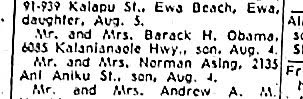
The column in which the birth announcement appears (it's hard to see, but it's the fourth announcement from the bottom):

The question of eligiblity for the presidency has come up before. John McCain was not born in the United States (as that is generally understood) but was born at a U.S. military installation, in Panama (and to U.S. parents). So he was generally accounted eligible. Questions have also arisen about George Romney, Chester Arthur, and others, who were--or may have been--born outside of the United States, though born as citizens because their parents were U.S. citizens. (George Romney was born in Mexico.) Questions were even raised about Barry Goldwater because he was born in Arizona before it became a state. Wikipedia has an article on the issue, noting among other things that the precise meaning of "natural born citizen" (the constitutional requirement) has never been determined (see http://en.wikipedia.org/wiki/Natural-born_citizen).
Recently, Senator Richard Shelby of Alabama was reported as saying that, though people claim Obama was born in Hawaii, "I haven't seen any birth certificate," and "You have to be born in America to be president."
Well, here's Senator Shelby's chance. What follow are photos of a certified copy of Obama's birth certificate, taken by researchers for FactCheck.org. Their full report can be found at http://www.factcheck.org/elections-2008/born_in_the_usa.html.
They also include photos of a birth announcement that appeared in a Honolulu newspaper on August 12, 1961, again confirming the August 4 birth of the boy who would become President Obama. I've also reproduced that announcement below.
Some still ask, "Why can't we see the original complete form filled out at the hospital in 1961?" Apparently, Hawaii law provides only for requesting a certified copy, not for getting a photograph of the original form. I believe that's typical of many states. For those who don't want to believe the evidence, even a photograph of the original paperwork might not be sufficient. They might want to go to Honolulu, see if they can get the authorities to let them see the paperwork, maybe even get permission to do tests on the paper to determine its age, etc., etc. But for most of us, a legally certified copy, along with a birth announcement appearing a few day's after Barack's birth, should be persuasive enough. I think that's also called "sanity."
(Click on any of the photos below to see larger versions.)


The birth announcement:
The column in which the birth announcement appears (it's hard to see, but it's the fourth announcement from the bottom):

Friday, February 20, 2009
Evolution and the LDS Church
Here's my standard explanation (with links):
BYU's Board of Trustees (which includes members of the First Presidency and Quorum of the Twelve) has stated, “there has never been a formal declaration from the First Presidency addressing the general matter of organic evolution as a process for development of biological species” (see the cover letter to the 1992 BYU Evolution Packet). Of humans, this letter states, “The scriptures tell why man was created, but they do not tell how.”
For details about official LDS positions on evolution, including material approved to be presented at BYU, plus some additional and very interesting items, see the following:
> http://whitinglab.byu.edu/
PDF/Evolution%20Packet.pdf
> http://cs.gmu.edu/~sean/stuff/
Evolution.html
> http://newsnet.byu.edu/story.cfm/
58046
> http://newsnet.byu.edu/story.cfm/
57999
> http://www.byui.edu/perspective/
contents4_2.htm
(an entire issue of a journal at BYU-Idaho on the subject; see especially http://www.byui.edu/perspective/
v4n2pdf/v4n2_ott_s.pdf )
BYU's Board of Trustees (which includes members of the First Presidency and Quorum of the Twelve) has stated, “there has never been a formal declaration from the First Presidency addressing the general matter of organic evolution as a process for development of biological species” (see the cover letter to the 1992 BYU Evolution Packet). Of humans, this letter states, “The scriptures tell why man was created, but they do not tell how.”
For details about official LDS positions on evolution, including material approved to be presented at BYU, plus some additional and very interesting items, see the following:
> http://whitinglab.byu.edu/
PDF/Evolution%20Packet.pdf
> http://cs.gmu.edu/~sean/stuff/
Evolution.html
> http://newsnet.byu.edu/story.cfm/
58046
> http://newsnet.byu.edu/story.cfm/
57999
> http://www.byui.edu/perspective/
contents4_2.htm
(an entire issue of a journal at BYU-Idaho on the subject; see especially http://www.byui.edu/perspective/
v4n2pdf/v4n2_ott_s.pdf )
Wednesday, February 18, 2009
Oxford, England (info from 1996)
Though this is from 1996, some of it is still valid. My main question is on the bus routes and the prices. I've added some more recent information (or clarification or correction) in square brackets.
Planning your visit to Oxford
As usual there’s more to do than you’ll have time for. You may want to make an extra visit to Oxford on your own (it’s easy and relatively cheap--take the "Oxford Tube," a bus that will pick you up on Bayswater Road practically across the street from Palace Court [--also various other spots in London]). I especially recommend that fans of C. S. Lewis make a special trip to see sites associated with him.
General sites to see (number of asterisks indicates how interesting or important I think a site is):
Carfax Tower (corner of High St. and Cornmarket St.--gives a nice view of the city)
*The Painted Room (#3 Cornmarket, associated with Shakespeare; I’ll see if I can get those who are interested in [it's one floor up, I think; a social services organization uses the space; they might show you if you just drop by, but they prefer having you arrange a visit])
**The Ashmolean Museum (there are a number of other museums in the city as well)
**Bodleian Library: one of the great libraries of the world; in the part known as the Divinity School (architecturally splendid) you may be able to see some of the library’s treasures, including Tottel’s Miscellany, Shakespeare’s Venus and Adonis, and original manuscripts by Donne, Shelley, Kenneth Grahame, T. E. Lawrence, and Joyce Cary.
**Radcliffe Camera, Sheldonian Theatre (architecturally important)
*St. Mary the Virgin Church (John Henry Newman preached hear before becoming a Catholic; he was part of the Oxford or Tractarian movement trying to make the Church of England more "Catholic"--i.e., more emphasis on tradition and authority; lots of other history)
*Martyr’s Memorial (memorial to Cranmer, Latimer, and Ridley, Protestant clergy who were interrogated in St. Mary’s and burned in Oxford, near the spot marked by the memorial [the actual spot of the burning is marked with an X in the pavement on Broad St., I believe; same street Blackwell's is on, but opposite end--i.e., to the west], during the reign of the Catholic queen Mary I; the memorial was erected partly in reaction to the Tractarian movement)
**Blackwell's [an amazing bookstore]
Saxon Tower of St. Michael (at Northgate; one of Oxford’s most ancient buildings)
**The various colleges (especially Christ Church [see more below], University [statue of Shelley], Magdalen [see under C. S. Lewis sites]; also noted historically, artistically, or architecturally are New College, All Souls, St. John’s, and Keble [has Holman Hunt’s painting The Light of the World in its chapel])
**Christ Church College (an outstanding college associated with various figures including Charles Dodgson, the author of the Alice books; see the chapel, which is also Oxford’s cathedral; the Great Hall, which has a window devoted to Alice; and other sites at the college; also see Alice’s Shop, with Alice in Wonderland memorabilia, across the street from the college) [this is also the college where parts of Harry Potter were filmed]
"The Oxford Story," 6 Broad St., open 10am-4pm (a multimedia creation from the same people who brought you the Jorvik Center; I haven’t seen the Oxford Story, but I might try it out)
Golden Cross Inn on Cornmarket St. (One of Oxford’s oldest; plays by Shakespeare are said to have been performed in the yard)
Merton St.: 13th century cobbled street
The site of William Morris’s original workshop (corner of Holywell and Longwall St.)
A bit of the city wall (corner of Longwall and High St.)
Note that walking tours of the city are given by official guides (for £4) and by students (varies: about £2), usually starting either from Carfax or from the Oxford Information Centre, Gloucester Green. The guides gives lots of interesting information as they take you to various colleges.
[note also that there are several walking tours that start from Blackwell's, including an "Inklings" tour around 11 or so on Wednesdays]
C. S. Lewis sites:
The Lewis sites come mainly in 3 groups--
(1) Pubs on St. Giles St.: The Eagle and the Child (familiarly known as the "Bird and the Baby"), where Lewis met regularly with his friends, including J. R. R. Tolkien, to talk, etc. (the group was known as "the Inklings"); during certain periods they also met at the Lamb and the Flag, a pub across the street. In the Eagle and the Child (which is now a bit grungy) you can see the room where the group met; there are pictures and plaques on the wall.
(2) Colleges associated with Lewis: University College, where he was an undergraduate; and especially Magdalen College, where he taught for many years. Magdalen College is interesting in its own right. You can see the quadrangles, cloisters, and chapel. Lewis had rooms where he taught students and met with his friends in what are called the New Buildings ("new" means 1733). From the New Buildings you can go through a blue iron gate to "Addison’s Walk," a nice walk that is important for Lewis because it was while walking here late at night with J. R. R. Tolkien and another friend that Lewis came to more fully accept Christianity and understand its importance.
(3) About 3 miles from the center of Oxford (in an area called "Headington Quarry") is Lewis’s home ("the Kilns" on a street now called Lewis Close), a nature preserve behind his home (once part of his property; it’s a magic place--I think of it as a part of Narnia, or maybe the Wood between the Worlds), and Holy Trinity Church (Lewis attended church there; if you can get the vicar to open the church you can sit in Lewis’s pew and see the Narnia window next to it; you can also see Lewis’s grave in the churchyard).
You can pretty easily see the sites listed under (1) and (2) during our group daytrip to Oxford. To see the sites under (3) you’ll probably have to come another time. For those who are interested (either for this trip or later), I can provide a map and some suggested itineraries, including bus #’s and other information for getting to the Lewis sites.
Literary figures associated with the Colleges
Some of these are mentioned on Rachel and Rebecca’s handout. This is a supplementary listing that will help you to know which literary figures were students at (or were otherwise associated with) particular Oxford colleges. (But note that this is only a very small selection.)
All Soul’s: William Camden, Jeremy Taylor, Edward Young, T. E. Lawrence ("Lawrence of Arabia").
Balliol: John Wycliffe, Adam Smith, Robert Southey (visited by Coleridge), Matthew Arnold, Algernon Swinburne, Andrew Lang, Gerard Manley Hopkins, A. C. Bradley, Hilaire Belloc, Aldous Huxley, Arnold Toynbee.
Brasenose: Robert Burton, Thomas Traherne, Walter Pater.
Christ Church: Thomas More, Philip Sidney, Robert Burton, John Locke, John Ruskin, Oscar Wilde, Charles Dodgson ("Lewis Carroll"), W. H. Auden.
Corpus Christi: Robert Bridges.
Exeter: John Ford, William Morris (there’s a Morris tapestry in the chapel), J. R. R. Tolkien.
Hertford: Samuel Daniel, John Donne, Evelyn Waugh.
Jesus: Henry Vaughan.
Lincoln: William D’Avenant.
Magdalen (pronounced "Mawdlin"): John Foxe, John Lyly, Joseph Addison, Edward Gibbon, Oscar Wilde, C. S. Lewis (as teacher).
Magdalen Hall: Thomas Hobbes; John Keats visited.
Merton: Philip Massinger, Thomas Carew, Richard Steele, Andrew Lang, Max Beerbohm, J. R. R. Tolkien (as teacher).
New College: John Galsworthy.
Oriel: Walter Ralegh, Gilbert White, John Henry Newman, Arthur Hugh Clough, Matthew Arnold (as teacher).
Pembroke: Francis Beaumont, Thomas Browne, Samuel Johnson (started but didn’t finish).
Queen’s: John Davies, Thomas Middleton, William Wycherley, Walter Pater (as student), T. H. White (author of The Once and Future King).
St. John’s: James Shirley, Abraham Cowley, A. E. Housman.
Somerville: Dorothy Sayers (devoted Christian and writer of detective stories, described in her student days as an "exuberant young female" who always seemed to be preparing for parties).
Trinity: Thomas Lodge, John Denham, John Henry Newman, Joyce Cary; Johnson and Boswell visited when Johnson received an honorary degree.
University: Percy Bysshe Shelley (see other handout on his being kicked out and now having a monument), C. S. Lewis (as student).
Worcester: Richard Lovelace, Thomas de Quincey.
*******************
[be skeptical of the accuracy of prices and bus route numbers]
Bruce Young: Possible ways to spend a day in Oxford (including C. S. Lewis sites)
Since you won’t have time to see everything, I’m presenting two itineraries based on seeing only the C. S. Lewis sites near the center of Oxford and two itineraries that include Lewis sites both near the center and on the outskirst of Oxford.
Itinerary #1: Pay an official city guide (Oxford Information Centre, Gloucester Green) or a student guide (Carfax--corner of High St. and Cornmarket St.) to take you on a walking tour. Some tours will differ from others, but most guides will take you to a variety of colleges, giving you interesting information about them. Some guides will know about C. S. Lewis; others will not. Your tour may or may not take you to significant Lewis sites.
Itinerary #2 (self-guided tour including a few Lewis sites):
(a) Go from the coach park (on Oxpens Road) to St. Aldates Street. (About 15 minutes)
(b) Stop at Christ Church College on St. Aldates: see the chapel (some pre-Raphaelite stained glass windows, etc.), the quad, the great hall (a window is devoted to Alice of Alice in Wonderland). (About 30 minutes)
(c) Go across the street to the Alice Shop. (About 15 minutes)
(d) Go north on St. Aldates to Carfax (the intersection with High Street) (About 10 minutes)
(e) If you’d like, pay to go to the top of Carfax Tower (nice view of the city) and/or go to “the Painted Room” (Shakespearean site) on the 2nd floor of #3 Cornmarket St. (About 15 minutes)
(f) Continue north on Cornmarket St., maybe look at the Golden Cross Inn, the Saxon Tower of St. Michael’s Church. (10-20 minutes)
(g) Continue north as Cornmarket St. becomes Magdalen St. and take a look at the “Martyr’s Memorial” (5-10 minutes)
(Note: The Ashmolean Museum is nearby, on Beaumont St., but this itinerary doesn’t allow time for it.)
(h) Continue north as Magdalen St. becomes St. Giles until you spot the Eagle and the Child pub (west side of St. Giles); go in and see the room where C. S. Lewis, J. R. R. Tolkien, and their friends hung out; also look across the street at the Lamb and the Flag pub (10-15 minutes)
(i) Go back south down St. Giles/Magdalen St. and turn left on Broad St., continuing until you see the Sheldonian Theatre; look at it, go south past it to the Bodleian Library (go into the Divinity School, look at the ceiling and at any displays they have); continue south and look at the Radcliffe Camera; continue south and take a look at St. Mary’s Church (where John Henry Newman preached), maybe go in (About 20-30 minutes)
(j) Just to the south of St. Mary’s Church is High St.; go east on High St.; take a peek in University College if you’d like, see the statue of Shelley (About 10 minutes)
(k) Continue east on High St. to the intersection with Longwall St. (you’ll see bits of the old city wall); continue on a bit until you come (on the left) to the entrance to Magdalen College; pay to go in; see what you have time to see, including the New Buildings (where Lewis taught and met with friends) and Addison’s Walk (About 40-50 minutes)
(l) Leave Magdalen College the way you came in; go west on High St.; if you’d like take a left onto cobblestoned Merton St. when you get there and wind your way back to St. Aldates; head back to the coach park (About 20-30 minutes)
Itinerary #3 (self-guided tour including more Lewis sites--and fewer other sites):
(a) Go from the coach park (on Oxpens) past Carfax (intersection of Cornmarket and High St.); continue north a little ways on Cornmarket St. to the #7 bus stop in front of Boots (on the east side of Cornmarket St.); pay a small amount (I believe 70p) to take the bus. (About 20 minutes from Oxpens to the bus stop)
(b) Take the #7 bus (it will go up St. Clement’s, Headington Rd., and London Rd.) to the intersection of London Rd. And Gladstone Rd. (shortly before the bus reaches Green Road) (About 15 minutes)
(c) Walk to Trinity Road (see map) and find Holy Trinity Church; look at Lewis’s grave in the churchyard; if the church isn’t open and you’d like to see the inside, find the vicar (in a house you can reach down a lane from the west side of the churchyard); you can sit in the pew where Lewis sat and see the Narnia window (All this should take about 30-45 minutes)
(d) Walk from Trinity Church to Lewis Close (see map) and look at the Kilns (the house Lewis lived in--it probably won’t be open); at the end of Lewis Close look for a trail into a nature preserve that used to be part of Lewis’s property; maybe have a picnic? fantasize about Narnia? (About 30-60 minutes)
(e) Walk back to London Road and catch a bus (#7 or #2A) back to the center of Oxford (again about 70p); get off when it gets to High Street, near Magdalen College (About 15 minutes)
(f) Enter Magdalen College (you’ll probably have to pay); see what you have time to see, including the New Buildings (where Lewis taught and met with friends) and Addison’s Walk (About 40-50 minutes)
(g) Go out Magdalen College the way you came in; walk west on High St. (notice the old city wall); pop in University College if you have time (Lewis was an undergraduate here; there’s an intersting statue of Shelley); see other sites if you have time as you head toward St. Giles St. (see map); on the west side of St. Giles a couple of blocks north of the Ashmolean Museum, you’ll find the Eagle and the Child pub, where Lewis, Tolkien, and friends hung out (go in and see the room they used; also look across the street at the Lamb and the Flag, where they also sometimes met) (All of this: about 30-45 minutes)
(h) Walk south down St. Giles/Magdalen St./Cornmarket St., past Carfax as the street becomes St. Aldates, and find your way back to the coach park on Oxpens (About 20-30 minutes)
Itinerary #4 (similar to #3 but going on your own to Oxford another day):
(a) Catch the “Oxford Tube” (a bus) going to Oxford. You get the Oxford Tube on the other side (south side) of Bayswater Road across the street from the junction of Palace Court and Bayswater Road (and a little to the right). The cost is £6 return for students; buses come about every 10 minutes through most of the day and take about 1 ½ hours to Oxford.
(b) You can get off the bus in Oxford either (1) at the Green Road Roundabout, (2) at Queens Lane (the junction of High St. and Queens Lane), or (3) at Gloucester Green. If you get off at #2 or #3 you’ll be in the heart of Oxford and can proceed according to one of the itineraries above. If you get off at the Green Road Roundabout, you’ll be close the the C. S. Lewis sites in Headington Quarry: Trinity Church, the Kilns, and the nature preserve.
(c) After seeing the sites in Oxford (see the itineraries above) you can catch the Oxford Tube to get back to London (you’ll need to save your return ticket to show when you get on). You can catch it either at Gloucester Green, Queens Lane (on High St.), the Headington Post Office, or the Green Road Roundabout.
**********************
[[from a fellow named Will Vaus:]
Date sent: Thu, 25 Jun 1998 09:37:03 -0400
From: William J Vaus
Subject: Re: Places to visit in Oxford
To Oxford travelers,
Here are some places you may wish to visit in and around Oxford, directly
related to Lewis:
Bodleian Library - the Duke Humphries Library where Lewis often studied
as an undergraduate. This is one of two main repositories of Lewis'
letters and manuscripts. The other being Wheaton College in Illinois.
Lewis' original map of Narnia is on display in the Divinity School here.
Eagle & Child Pub where Lewis met every Tuesday with the Inklings. They
moved to the Lamb and Flag, across the street, in 1962.
The University Church of St. Mary the Virgin is where Lewis preached
"The Weight of Glory" in June 1941.
University College on the High Street where Lewis was an undergraduate
student
Merton College where Tolkien was a professor. See Tolkien's grave in the
cemetary at Wolvercote, to the northwest of Oxford, best approached on
foot across Port Meadow.
Charles Williams' grave may be seen in the cemetary behind the church of
St. Cross, Holywell.
Magdalen College. See New Buildings where Lewis had his rooms during his
30 years at Oxford as a fellow and tutor. Lewis' rooms overlooked the
Deer Park & Addison's Walk, which you will want to take a stroll around.
This is where Lewis walked with Tolkien and Hugo Dyson and discussed
Christianity on that very important night in 1931. He became a Christian
a few days later on a trip to Whipsnade Zoo outside of London. Be sure
to see the College Chapel where Lewis attended Matins during term.
Examination Schools where Lewis and Tolkien frequently lectured.
Eastgate Hotel where Lewis often met guests, like Sheldon Vanauken, for
lunch
Joy Davidman's former home at 10 Old High Street in Headington
The Kilns in Headington Quarry. Be sure to walk in the woods and view
the lake in which Shelley sailed paper boats, and more recently Lewis,
Davidman, Tolkien, Lancelyn-Green and George Sayer would stroll, deep in
thought or alive with conversation.
Holy Trinity Church and Lewis' grave -- Headington Quarry. Be sure to
see the Narnia Window inside.
Six Bells Pub in Headington -- frequented by the Lewises it now has some
Lewis memorabilia on one wall.
Oxford Crematorium where Joy Davidman's ashes are interred
Trout Inn in Godstow - a favorite pub of the Lewises
Studley Priory Hotel - where Jack and Joy often went for Sunday lunch.
Studley Priory was built in the 16th century as a Nunnery. During Lewis'
lifetime it was run as a sort of country club where Jack and many of his
friends were members. Subsequently the place was sold and made into a
hotel. Jack and Joy would go there often for lunch, afternoon tea, and
sometimes for dinner. The "Mary Tudor Parlour" has been used as a dining
room for about 400 years!
Under the Mercy,
Will Vaus]
Planning your visit to Oxford
As usual there’s more to do than you’ll have time for. You may want to make an extra visit to Oxford on your own (it’s easy and relatively cheap--take the "Oxford Tube," a bus that will pick you up on Bayswater Road practically across the street from Palace Court [--also various other spots in London]). I especially recommend that fans of C. S. Lewis make a special trip to see sites associated with him.
General sites to see (number of asterisks indicates how interesting or important I think a site is):
Carfax Tower (corner of High St. and Cornmarket St.--gives a nice view of the city)
*The Painted Room (#3 Cornmarket, associated with Shakespeare; I’ll see if I can get those who are interested in [it's one floor up, I think; a social services organization uses the space; they might show you if you just drop by, but they prefer having you arrange a visit])
**The Ashmolean Museum (there are a number of other museums in the city as well)
**Bodleian Library: one of the great libraries of the world; in the part known as the Divinity School (architecturally splendid) you may be able to see some of the library’s treasures, including Tottel’s Miscellany, Shakespeare’s Venus and Adonis, and original manuscripts by Donne, Shelley, Kenneth Grahame, T. E. Lawrence, and Joyce Cary.
**Radcliffe Camera, Sheldonian Theatre (architecturally important)
*St. Mary the Virgin Church (John Henry Newman preached hear before becoming a Catholic; he was part of the Oxford or Tractarian movement trying to make the Church of England more "Catholic"--i.e., more emphasis on tradition and authority; lots of other history)
*Martyr’s Memorial (memorial to Cranmer, Latimer, and Ridley, Protestant clergy who were interrogated in St. Mary’s and burned in Oxford, near the spot marked by the memorial [the actual spot of the burning is marked with an X in the pavement on Broad St., I believe; same street Blackwell's is on, but opposite end--i.e., to the west], during the reign of the Catholic queen Mary I; the memorial was erected partly in reaction to the Tractarian movement)
**Blackwell's [an amazing bookstore]
Saxon Tower of St. Michael (at Northgate; one of Oxford’s most ancient buildings)
**The various colleges (especially Christ Church [see more below], University [statue of Shelley], Magdalen [see under C. S. Lewis sites]; also noted historically, artistically, or architecturally are New College, All Souls, St. John’s, and Keble [has Holman Hunt’s painting The Light of the World in its chapel])
**Christ Church College (an outstanding college associated with various figures including Charles Dodgson, the author of the Alice books; see the chapel, which is also Oxford’s cathedral; the Great Hall, which has a window devoted to Alice; and other sites at the college; also see Alice’s Shop, with Alice in Wonderland memorabilia, across the street from the college) [this is also the college where parts of Harry Potter were filmed]
"The Oxford Story," 6 Broad St., open 10am-4pm (a multimedia creation from the same people who brought you the Jorvik Center; I haven’t seen the Oxford Story, but I might try it out)
Golden Cross Inn on Cornmarket St. (One of Oxford’s oldest; plays by Shakespeare are said to have been performed in the yard)
Merton St.: 13th century cobbled street
The site of William Morris’s original workshop (corner of Holywell and Longwall St.)
A bit of the city wall (corner of Longwall and High St.)
Note that walking tours of the city are given by official guides (for £4) and by students (varies: about £2), usually starting either from Carfax or from the Oxford Information Centre, Gloucester Green. The guides gives lots of interesting information as they take you to various colleges.
[note also that there are several walking tours that start from Blackwell's, including an "Inklings" tour around 11 or so on Wednesdays]
C. S. Lewis sites:
The Lewis sites come mainly in 3 groups--
(1) Pubs on St. Giles St.: The Eagle and the Child (familiarly known as the "Bird and the Baby"), where Lewis met regularly with his friends, including J. R. R. Tolkien, to talk, etc. (the group was known as "the Inklings"); during certain periods they also met at the Lamb and the Flag, a pub across the street. In the Eagle and the Child (which is now a bit grungy) you can see the room where the group met; there are pictures and plaques on the wall.
(2) Colleges associated with Lewis: University College, where he was an undergraduate; and especially Magdalen College, where he taught for many years. Magdalen College is interesting in its own right. You can see the quadrangles, cloisters, and chapel. Lewis had rooms where he taught students and met with his friends in what are called the New Buildings ("new" means 1733). From the New Buildings you can go through a blue iron gate to "Addison’s Walk," a nice walk that is important for Lewis because it was while walking here late at night with J. R. R. Tolkien and another friend that Lewis came to more fully accept Christianity and understand its importance.
(3) About 3 miles from the center of Oxford (in an area called "Headington Quarry") is Lewis’s home ("the Kilns" on a street now called Lewis Close), a nature preserve behind his home (once part of his property; it’s a magic place--I think of it as a part of Narnia, or maybe the Wood between the Worlds), and Holy Trinity Church (Lewis attended church there; if you can get the vicar to open the church you can sit in Lewis’s pew and see the Narnia window next to it; you can also see Lewis’s grave in the churchyard).
You can pretty easily see the sites listed under (1) and (2) during our group daytrip to Oxford. To see the sites under (3) you’ll probably have to come another time. For those who are interested (either for this trip or later), I can provide a map and some suggested itineraries, including bus #’s and other information for getting to the Lewis sites.
Literary figures associated with the Colleges
Some of these are mentioned on Rachel and Rebecca’s handout. This is a supplementary listing that will help you to know which literary figures were students at (or were otherwise associated with) particular Oxford colleges. (But note that this is only a very small selection.)
All Soul’s: William Camden, Jeremy Taylor, Edward Young, T. E. Lawrence ("Lawrence of Arabia").
Balliol: John Wycliffe, Adam Smith, Robert Southey (visited by Coleridge), Matthew Arnold, Algernon Swinburne, Andrew Lang, Gerard Manley Hopkins, A. C. Bradley, Hilaire Belloc, Aldous Huxley, Arnold Toynbee.
Brasenose: Robert Burton, Thomas Traherne, Walter Pater.
Christ Church: Thomas More, Philip Sidney, Robert Burton, John Locke, John Ruskin, Oscar Wilde, Charles Dodgson ("Lewis Carroll"), W. H. Auden.
Corpus Christi: Robert Bridges.
Exeter: John Ford, William Morris (there’s a Morris tapestry in the chapel), J. R. R. Tolkien.
Hertford: Samuel Daniel, John Donne, Evelyn Waugh.
Jesus: Henry Vaughan.
Lincoln: William D’Avenant.
Magdalen (pronounced "Mawdlin"): John Foxe, John Lyly, Joseph Addison, Edward Gibbon, Oscar Wilde, C. S. Lewis (as teacher).
Magdalen Hall: Thomas Hobbes; John Keats visited.
Merton: Philip Massinger, Thomas Carew, Richard Steele, Andrew Lang, Max Beerbohm, J. R. R. Tolkien (as teacher).
New College: John Galsworthy.
Oriel: Walter Ralegh, Gilbert White, John Henry Newman, Arthur Hugh Clough, Matthew Arnold (as teacher).
Pembroke: Francis Beaumont, Thomas Browne, Samuel Johnson (started but didn’t finish).
Queen’s: John Davies, Thomas Middleton, William Wycherley, Walter Pater (as student), T. H. White (author of The Once and Future King).
St. John’s: James Shirley, Abraham Cowley, A. E. Housman.
Somerville: Dorothy Sayers (devoted Christian and writer of detective stories, described in her student days as an "exuberant young female" who always seemed to be preparing for parties).
Trinity: Thomas Lodge, John Denham, John Henry Newman, Joyce Cary; Johnson and Boswell visited when Johnson received an honorary degree.
University: Percy Bysshe Shelley (see other handout on his being kicked out and now having a monument), C. S. Lewis (as student).
Worcester: Richard Lovelace, Thomas de Quincey.
*******************
[be skeptical of the accuracy of prices and bus route numbers]
Bruce Young: Possible ways to spend a day in Oxford (including C. S. Lewis sites)
Since you won’t have time to see everything, I’m presenting two itineraries based on seeing only the C. S. Lewis sites near the center of Oxford and two itineraries that include Lewis sites both near the center and on the outskirst of Oxford.
Itinerary #1: Pay an official city guide (Oxford Information Centre, Gloucester Green) or a student guide (Carfax--corner of High St. and Cornmarket St.) to take you on a walking tour. Some tours will differ from others, but most guides will take you to a variety of colleges, giving you interesting information about them. Some guides will know about C. S. Lewis; others will not. Your tour may or may not take you to significant Lewis sites.
Itinerary #2 (self-guided tour including a few Lewis sites):
(a) Go from the coach park (on Oxpens Road) to St. Aldates Street. (About 15 minutes)
(b) Stop at Christ Church College on St. Aldates: see the chapel (some pre-Raphaelite stained glass windows, etc.), the quad, the great hall (a window is devoted to Alice of Alice in Wonderland). (About 30 minutes)
(c) Go across the street to the Alice Shop. (About 15 minutes)
(d) Go north on St. Aldates to Carfax (the intersection with High Street) (About 10 minutes)
(e) If you’d like, pay to go to the top of Carfax Tower (nice view of the city) and/or go to “the Painted Room” (Shakespearean site) on the 2nd floor of #3 Cornmarket St. (About 15 minutes)
(f) Continue north on Cornmarket St., maybe look at the Golden Cross Inn, the Saxon Tower of St. Michael’s Church. (10-20 minutes)
(g) Continue north as Cornmarket St. becomes Magdalen St. and take a look at the “Martyr’s Memorial” (5-10 minutes)
(Note: The Ashmolean Museum is nearby, on Beaumont St., but this itinerary doesn’t allow time for it.)
(h) Continue north as Magdalen St. becomes St. Giles until you spot the Eagle and the Child pub (west side of St. Giles); go in and see the room where C. S. Lewis, J. R. R. Tolkien, and their friends hung out; also look across the street at the Lamb and the Flag pub (10-15 minutes)
(i) Go back south down St. Giles/Magdalen St. and turn left on Broad St., continuing until you see the Sheldonian Theatre; look at it, go south past it to the Bodleian Library (go into the Divinity School, look at the ceiling and at any displays they have); continue south and look at the Radcliffe Camera; continue south and take a look at St. Mary’s Church (where John Henry Newman preached), maybe go in (About 20-30 minutes)
(j) Just to the south of St. Mary’s Church is High St.; go east on High St.; take a peek in University College if you’d like, see the statue of Shelley (About 10 minutes)
(k) Continue east on High St. to the intersection with Longwall St. (you’ll see bits of the old city wall); continue on a bit until you come (on the left) to the entrance to Magdalen College; pay to go in; see what you have time to see, including the New Buildings (where Lewis taught and met with friends) and Addison’s Walk (About 40-50 minutes)
(l) Leave Magdalen College the way you came in; go west on High St.; if you’d like take a left onto cobblestoned Merton St. when you get there and wind your way back to St. Aldates; head back to the coach park (About 20-30 minutes)
Itinerary #3 (self-guided tour including more Lewis sites--and fewer other sites):
(a) Go from the coach park (on Oxpens) past Carfax (intersection of Cornmarket and High St.); continue north a little ways on Cornmarket St. to the #7 bus stop in front of Boots (on the east side of Cornmarket St.); pay a small amount (I believe 70p) to take the bus. (About 20 minutes from Oxpens to the bus stop)
(b) Take the #7 bus (it will go up St. Clement’s, Headington Rd., and London Rd.) to the intersection of London Rd. And Gladstone Rd. (shortly before the bus reaches Green Road) (About 15 minutes)
(c) Walk to Trinity Road (see map) and find Holy Trinity Church; look at Lewis’s grave in the churchyard; if the church isn’t open and you’d like to see the inside, find the vicar (in a house you can reach down a lane from the west side of the churchyard); you can sit in the pew where Lewis sat and see the Narnia window (All this should take about 30-45 minutes)
(d) Walk from Trinity Church to Lewis Close (see map) and look at the Kilns (the house Lewis lived in--it probably won’t be open); at the end of Lewis Close look for a trail into a nature preserve that used to be part of Lewis’s property; maybe have a picnic? fantasize about Narnia? (About 30-60 minutes)
(e) Walk back to London Road and catch a bus (#7 or #2A) back to the center of Oxford (again about 70p); get off when it gets to High Street, near Magdalen College (About 15 minutes)
(f) Enter Magdalen College (you’ll probably have to pay); see what you have time to see, including the New Buildings (where Lewis taught and met with friends) and Addison’s Walk (About 40-50 minutes)
(g) Go out Magdalen College the way you came in; walk west on High St. (notice the old city wall); pop in University College if you have time (Lewis was an undergraduate here; there’s an intersting statue of Shelley); see other sites if you have time as you head toward St. Giles St. (see map); on the west side of St. Giles a couple of blocks north of the Ashmolean Museum, you’ll find the Eagle and the Child pub, where Lewis, Tolkien, and friends hung out (go in and see the room they used; also look across the street at the Lamb and the Flag, where they also sometimes met) (All of this: about 30-45 minutes)
(h) Walk south down St. Giles/Magdalen St./Cornmarket St., past Carfax as the street becomes St. Aldates, and find your way back to the coach park on Oxpens (About 20-30 minutes)
Itinerary #4 (similar to #3 but going on your own to Oxford another day):
(a) Catch the “Oxford Tube” (a bus) going to Oxford. You get the Oxford Tube on the other side (south side) of Bayswater Road across the street from the junction of Palace Court and Bayswater Road (and a little to the right). The cost is £6 return for students; buses come about every 10 minutes through most of the day and take about 1 ½ hours to Oxford.
(b) You can get off the bus in Oxford either (1) at the Green Road Roundabout, (2) at Queens Lane (the junction of High St. and Queens Lane), or (3) at Gloucester Green. If you get off at #2 or #3 you’ll be in the heart of Oxford and can proceed according to one of the itineraries above. If you get off at the Green Road Roundabout, you’ll be close the the C. S. Lewis sites in Headington Quarry: Trinity Church, the Kilns, and the nature preserve.
(c) After seeing the sites in Oxford (see the itineraries above) you can catch the Oxford Tube to get back to London (you’ll need to save your return ticket to show when you get on). You can catch it either at Gloucester Green, Queens Lane (on High St.), the Headington Post Office, or the Green Road Roundabout.
**********************
[[from a fellow named Will Vaus:]
Date sent: Thu, 25 Jun 1998 09:37:03 -0400
From: William J Vaus
Subject: Re: Places to visit in Oxford
To Oxford travelers,
Here are some places you may wish to visit in and around Oxford, directly
related to Lewis:
Bodleian Library - the Duke Humphries Library where Lewis often studied
as an undergraduate. This is one of two main repositories of Lewis'
letters and manuscripts. The other being Wheaton College in Illinois.
Lewis' original map of Narnia is on display in the Divinity School here.
Eagle & Child Pub where Lewis met every Tuesday with the Inklings. They
moved to the Lamb and Flag, across the street, in 1962.
The University Church of St. Mary the Virgin is where Lewis preached
"The Weight of Glory" in June 1941.
University College on the High Street where Lewis was an undergraduate
student
Merton College where Tolkien was a professor. See Tolkien's grave in the
cemetary at Wolvercote, to the northwest of Oxford, best approached on
foot across Port Meadow.
Charles Williams' grave may be seen in the cemetary behind the church of
St. Cross, Holywell.
Magdalen College. See New Buildings where Lewis had his rooms during his
30 years at Oxford as a fellow and tutor. Lewis' rooms overlooked the
Deer Park & Addison's Walk, which you will want to take a stroll around.
This is where Lewis walked with Tolkien and Hugo Dyson and discussed
Christianity on that very important night in 1931. He became a Christian
a few days later on a trip to Whipsnade Zoo outside of London. Be sure
to see the College Chapel where Lewis attended Matins during term.
Examination Schools where Lewis and Tolkien frequently lectured.
Eastgate Hotel where Lewis often met guests, like Sheldon Vanauken, for
lunch
Joy Davidman's former home at 10 Old High Street in Headington
The Kilns in Headington Quarry. Be sure to walk in the woods and view
the lake in which Shelley sailed paper boats, and more recently Lewis,
Davidman, Tolkien, Lancelyn-Green and George Sayer would stroll, deep in
thought or alive with conversation.
Holy Trinity Church and Lewis' grave -- Headington Quarry. Be sure to
see the Narnia Window inside.
Six Bells Pub in Headington -- frequented by the Lewises it now has some
Lewis memorabilia on one wall.
Oxford Crematorium where Joy Davidman's ashes are interred
Trout Inn in Godstow - a favorite pub of the Lewises
Studley Priory Hotel - where Jack and Joy often went for Sunday lunch.
Studley Priory was built in the 16th century as a Nunnery. During Lewis'
lifetime it was run as a sort of country club where Jack and many of his
friends were members. Subsequently the place was sold and made into a
hotel. Jack and Joy would go there often for lunch, afternoon tea, and
sometimes for dinner. The "Mary Tudor Parlour" has been used as a dining
room for about 400 years!
Under the Mercy,
Will Vaus]
Wednesday, February 4, 2009
England, July 22-August 2, 2008
The following are excerpts from e-mails I wrote--and sent to my wife, Margaret--while in England last summer (for a very brief summary, see http://faceofother.blogspot.com/2009/02/didnt-i-go-to-england-last-summer.html):
7/22/08
(Tues.)
For now, I'm just trying to keep my eyes open. It's not even 6pm, but considering that I only got a couple of hours of sleep and that we arrived in London at about 1:30am our time, I'm struggling a bit.
Everything on the trip went smoothly. Having done it a year ago, I didn't get obsessive about planning out every detail, and I didn't worry when some things didn't work initially, like having the right kind of adapter to plug in my laptop. I ended up going to four or five different stores today until I found the right kind.
On the plane from Salt Lake to Dallas I sat next to Elder Howell. Yes, there were six missionaries headed for Paris on the plane, all from the other French-speaking branch. Elder Howell had been one of the zone leaders. He recognized me from the halls in the classroom building. The missionaries also went to London (on their way to Paris), but not on the same flight I was on, so I didn't seem them again after Dallas.
I saw lots of movies & TV shows on the flight from Dallas to London: the movie "21" (not as good as I hoped it would be--well acted and interesting at points, but a bit fuzzy in its moral orientation, and a bit too dazzled by Las Vegas); most of "Flawless" (pretty good); three episodes of "The Office" (REALLY funny--especially two of them), and episode of "Monk" (which of course I was already familiar with). And I put on another episode of it to help me fall asleep (I guess I'm hooked on that method). They no longer show a single movie during a flight, but have several movies and TV shows available at each person's individual console. It shouldn't be surprising that the TV comedy category was represented by episodes of Monk and The Office (along with another series I'm not familiar with).
I took a coach from the airport to Oxford and then walked (with luggage) 3/4 of a mile from the bus station to the B&B. Kathryn Park is lovely and friendly. I cleaned up a bit and then headed off to do errands, see things, and generally keep myself awake. I visted the Brompton Oratory (associated with John Henry Newman ("Lead Kindly Light") and Gerard Manley Hopkins), went to several stores to find an adapter (as noted above), got some gifts for the Lifferths (including for Oliver), went to Blackwell's (an amazing bookstore--almost like a little city), looked around in St. Mary the Virgin church (where Lewis gave the sermon "The Weight of Glory" that includes the lines "It is a serious thing to live in a society of possible gods and goddesses . . ."; others who have given sermons there include John Wesley and John Henry Newman, and the church has other famous associations--with the Protestant martyrs burnt under Queen Mary, with Oxfam, and with lots of other things), went up the church tower to take a view of the city, visited "the Painted Room" (where Shakespeare stayed during his trips between London and Stratford), visited a couple of free to the public parts of the Bodleian Library, called you, and got a bite to eat.
Obviously I'm now back in my room, reading and writing e-mails.
**************
7/23/08
(Wed.)
I did Shakespeare stuff today, NOT Lewis stuff (or not much). Today has been good but with some frustrations (to be described). Because Hamlet in Stratford is basically sold out, I can't get tickets online; the site says to call. So I called twice today (paying 40 or 50 pence each time); the first time they didn't have a person to talk to me because they were "in training"; the second time it was after 5 (nobody, including the web site or the previous call, had said anything about having to call by 5). So I'll try tomorrow--but by the time they're open for calling, the train I would prefer taking to Stratford will already be gone. Anyway, it will all work out.
I didn't watch the time while at the train station today (I was just getting information and making one of those calls) and was ten minutes late for a walking tour I had wanted to do. So I missed it, and it won't happen again till next week--and with the C. S. Lewis conference, I may or may not be able to do it. It's an INKLINGS tour, meaning Lewis, Tolkien, and friends, and I would LOVE to do it. If I don't manage this trip, there's always next time I'm in Oxford--as long as it's on a Wednesday and I have 90 minutes to spare.
Because I missed that walking tour, I visited the Ashmolean Museum instead--amazing Minoan, Egyptian, Roman, Renaissance, etc., etc., stuff. And I saw TWO Shakespeare plays, both open-air productions here in Oxford: Twelfth Night in the afternoon and As You Like It in the evening. For both performances, especially the afternoon one, I had a major heck of a time keeping my eyes open and my mind focused. Adjusting to the sleeping schedule plus doing lots of walking means that when I sit down my body and mind want to sort of shut down. Nevertheless, even with my lack of focus, I could tell that the Twelfth Night production was sort of dumb. It was OK, but I've seen lots better. As You Like It was much better (and I was actually able to focus most of the time during this one). It was a fun, energetic production which took the play seriously enough I could identify with the characters and what they were going through. It was sort of vaguely set in the 60s, with some miniskirts (and tights), a few hippy outfits, and some fun 60s-ish versions of some of the songs. Also, even though they pushed the Touchstone-Audrey relationship a little further than the text authorizes, there was not the sort of stupid, gratuitous vulgarity that the Twelfth Night production had thrown in at a few points.
**************
7/24/08
(Thurs.)
My day: I called you from London and mentioned that I saw Chris Clark. [There was a double line at the Globe box office; I was in one of them. I overheard someone in the other line say "Utah Valley" and thought, "Is there a chance there are students from Utah here?" Then someone said, "Bruce Young!" It was Chris Clark, a friend who now teaches at Utah Valley University--formerly UVSC--with a group of UVU students he was leading on a trip to England.] Since the Globe didn't have a matinee and were sold out for tonight, I spent my time in London seeing a few places of interest: I took the Globe exhibition and theatre tour (saw the rehearsal going on for Timon of Athens), dropped in on Choral Evensong at St. Paul's Cathedral (some lovely singing, organ playing, and scripture reading), and dropped by the Houses of Parliament and Westminster Abbey and the British Library (but they were all closed by then). Of course, the main thing was just soaking in London a bit--the tube, the Thames, the tourists and townspeople (that's all I can think of starting with "t").
I'm now back in my room in Oxford getting ready to go down for the night--maybe I'll watch some Monk (I brought one of the disks). By the way, the Danish lady who's here saw my disk cover and asked if I like Monk--she's a big fan too. Apparently they have Monk on TV in Denmark.
***************
7/25/08
(Fri.)
Saw Patrick Stewart and Paul Scofield but didn't have a chance to talk with them. [Didn't actually see Paul Scofield--but more on that later.] It's late--10 to 1am. I'll tell you more later.
*****************
7/27/08
(Sun.)
Four things I wanted to reflect about to start with:
1. I'm enjoying my time here and trying to do my usual thing of cramming lots of stuff in. I'm finding, though, that I get tired, and my feet and knees really start hurting from the walking. I'm afraid I may not be quite up to what I used to do, and I'm feeling more empathy with people who have protested against my style of traveling.
2. I'm seeing a fair number of Brits, but there are lots and lots of tourists--it appears mainly Italians, Spaniards, Germans, along with (in London, at least) people from Africa and the Middle East. And Americans, of course. When I say "Brits," you have to remember that the Brits are increasingly multicultural--lots of people from India, Pakistan, etc., etc., some from Africa, too. You remember the elder we had a while back who was part Nigerian/part Irish, but lived in Australia? He seemed very British--very cultured, a nice British accent, etc. That's the sort of thing you'd notice now, as well as people who retain more of their ethnic identity.
3. There's far too much smoking here in England. I know there have been moves to curtail it, and there are places where it's prohibited. But you still see it (and smell it) lots, and unfortunately a lot of the smokers are young. It's hard to tell the tourists from the natives sometimes, but I think a lot of the smoking is by natives. Sad, unpleasant, unhealthy of course. I should say, though, that the bed & breakfast is entirely smoke free, which is nice. As for things it's nice to see: It's nice to see lots of young couples with prams (baby strollers), husband and wife sharing the duties. And I remember seeing a very pregnant woman crossing the street the other day and saying to myself, spontaneously, "Bless you."
4. I have not done lots of thinking about my mom or Lynda. But in high priests today the subject came up of whether it was selfish to grieve and I said, I think it's natural, and though it can conceivably be excessive or too negative, in general the Lord seems to approve. I quoted the Doctrine and Covenants: "Thou shalt live together in love insomuch that thou shalt weep for the loss of those who die"--something like that. Also, I was reading in Dreams from My Father the other day (I brought it with me), and I reread the new preface, where Obama talks about his mother's death, and it hit me MUCH more strongly than it had the first time I read it. And then that night (this was in Stratford), I saw Hamlet, and was again hit in an unusual way by the scene where Ophelia is buried. Laertes's reaction, his jumping into the grave and taking her into his arms, struck a chord. I've had a similar loss.
I guess there's lots to catch up on. This is my attempt at a short version, but I'm afraid it's a bit long.
THURSDAY, July 24: I was in London; I think I already told you about that--seeing Chris Clark, touring the Globe, going into St. Paul's, etc.
FRIDAY, July 25:
Stratford: Hamlet is completely sold out, but I got in the returns line (was 3rd out of 3) shortly before noon. Those who had lined up before dawn had already got their tickets. Amazingly some tickets became available shortly after noon, and I got one. There's such an interest because Hamlet is played by David Tennant, the current Dr. Who and very popular in England. But I was even more impressed by Patrick Stewart (Claudius) and the actor who played Polonius (can't remember his name at the moment).
After getting the ticket, I went to Holy Trinity Church (Shakespeare's grave), then later in the afternoon got together with Helen Hargest (the Shakespeare Centre librarian who has worked with me on images I've used, etc.). We had a nice talk.
I really enjoyed Hamlet, partly because I actually remained awake the entire time. (It probably helped that I had dozed off a bit while lying down in a park along the river doing some reading.) I was concerned, though, about making the train back to Oxford (it leaves at 11pm, with the play going to about 10:50). So I arranged to change my seat during the interval, gave mine to the wife of the guy who was sitting next to me (they'd gotten returns and had to sit in separate parts of the theatre). The new seat I was in was very good, though: still a nice view, but more than that, the aisle next to me was used as an entrance/exit. So David Tennant and Patrick Stewart walked past me several times and I could easily have stuck out my arm and hit them.
(I didn't. But I savored the breeze as they walked past.) I could swear also that I saw Paul Scofield sitting in the front row--but when I mentioned that to someone, they said, "He's dead." And indeed he is: died just last March. So maybe it was his brother?
I left the theatre at 10:45 and took a cab to the train station. As it turned out, though, I could have stayed in the theatre another 5 minutes and still made it to the train station 5 minutes before the train left. Anyway, I left just after both Hamlet and Laertes were mortally wounded. Gertrude was dying but Claudius had yet to be stabbed or have the poisoned drink forced down his throat. In other words, I missed the end of the play.
Anyway, I made the train, returned to Oxford, and got back to the B&B about 12:30am.
SATURDAY, July 26:
I went to London (it's a bus called "the Oxford Tube"--takes about 1 1/2 to 2 hrs. each way). I visited Westminster Abbey, which really is a pretty amazing place. They had a refreshment area in the cloisters and I had some "Victorian lemonade." After I'd drunk about half of it, I decided to look more carefully at the ingredients to see why it had a bit of a fizz to it.
It said, in very small print on the label, "No more than 0.5% alcohol." Oh well. I think that's about how some of the orange juice has been that's been left out for a while. Anyway, I'll have to be more careful in the future.
Still with some time on my hands, I went to Leicester Square and got a bit disoriented (very hard to figure out directions there, plus it looked like the place was clogged with maybe thousands of tourists). Anyway, I ended up at the National Portrait Gallery, and just looked at a few rooms with Tudor, Elizabethan, etc., portraits, many of them very famous and very familiar to me--famous ones of Shakespeare, John Donne, Ben Jonson, Queen Elizabeth, Jane Gray, Mary Tudor, Henry VIII, Richard III, Sir Thomas More and family, and lots of others. Also, a nice big portrait of Lady Anne Pope and her children--one of the images I use in my book. It was fun seeing the real thing.
Then I went through the Covent Garden area trying to find an African restaurant that, unfortunately, had moved; then found the Indian restaurant I called you from. It's called Masala Zone ( http://www.masalazone.com ) and is really very good. I'm planning to take you there when we're in London.
Unfortunately, I lost track of time. It was 6:55 when I left the restaurant and the play at the Globe started at 7:30. With some running and luck I found the Oxford Circus tube stop, took the tube to St. Paul's, found the Millennium Bridge, crossed the Thames, and made it in the theater about 7:25, very sweaty I'm afraid. I was a genuine groundling. I stood the entire performance, unfortunately in a bit of physical agony. The play was Timon of Athens, a powerful performance but not (I've decided) Shakespeare's best play by a long shot. A lot of it is speeches, intellectually, satirically, and very bitterly analyzing the foibles of mankind. The story itself is powerful, at a fairly simple level, with some affinities with Lear and Coriolanus but without the richness and personal interest. The acting was very good, but some of the directorial choices were disturbingly gross (or grossly disturbing), like have Timon appear to actually unload himself in a hole on stage and then smear the feces on other characters. I'll have to check and see if that's in the text.
After the play, I found a tube stop, made it back to Victoria Station, and caught the Oxford Tube, returning to Oxford about 1am and making it to the B&B by 1:15. (The lady who runs it gives her lodgers keys, so I'm able to come and go whenever I want.)
SUNDAY, July 27:
No trips today! I was able to sleep in until a little after 8am, had breakfast a little after 9, and then headed off to Church. I saw Paul and Sandy Thomas there, as well as some people from Southern Virginia University (Randall Cluff, I think is his name, remembered your visit there; plus a daughter of his took the class I taught with Bob Nelson; Randall said they'd like to maybe have me come out).
Church was good, especially some good talks and testimonies in Sacrament meeting. I did feel the Spirit, felt renewed--and I needed it, not only because of the rigors of travel but because, as I've learned, I tend to have a hard time being IN the world without being OF the world. In other words, I'm a bit passive, a bit of a chameleon, and tend to take on the coloration of my surroundings. I'm afraid I tend to get rather spiritually dull. So it was nice to feel revived. I would really like to become stronger, more truly radiant. I know I get that way in the right settings, but I'd like to be that way more fully, independent of circumstances or surroundings.
The Thomases gave me a ride to the B&B. I was on my own for the rest of the day, though, so I bought some food to get me through the day and spent most of the day in my room, e-mailing, listening to Obama's speech in Berlin and to Al Gore on becoming carbon-free within 10 years. Very persuasive, by the way--though I dozed off part way through his speech and had to go back to hear much of it; but I needed the rest, so that was good, too.
Also, I did more work on my paper for the C. S. Lewis conference.
And when BYU's server stopped working, I took a walk and made some phone calls (you, a 1 minute call to my dad, and leaving a message on Julie's phone--the e-mail address I have for her isn't working, so I want to know what the right one is).
*******
7/28/08
(Mon.)
Have you heard that an Orrin Hatch song may get played at the Democratic convention? See this for details: http://www.boston.com/news/nation/washington/articles/2008/07/16/across_the_aisle_a_ballad_to_kennedy/?s_campaign=8315
(It's a tribute to Teddy Kennedy. Some of the words are a bit embarrassing, but the story really is sweet.)
Also, I haven't heard: have you won the $5 prize from yesterday's e-mail? If not, check it again. I should maybe have made it in the form of a quiz:
(a) "I see dead people." Who in particular?
(b) What alcoholic beverage did I drink and where?
(c) What should Timon be sent to time out for doing?
OK, here's today. It's been a good day. There were some disappointments: Merton College (where Tolkien taught and where a beautiful library is located) is closed all summer to visitors. Museums (including the Ashmolean) were closed today because it's Monday. (But not Christ Church picture gallery, which I did visit.) And I didn't get to take a tour of the Bodleian Library because all the tickets had been sold by the time I got there.
On the other hand, I checked in with the C. S. Lewis conference, which begins in earnest tomorrow. I got my paper printed and copied at the local Staples (yes they have a branch here). I did some good reflecting and writing in my journal. And I saw a MARVELOUS performance of Much Ado tonight. It really is a great play, and it was greatly performed, by a theatre group right here in Oxford--outdoors, in the courtyard of the Oxford Castle (which had also served as a prison until 1996 but is now a tourist stop). The play was set in Spain (Sevilla), which worked really well. And it was done with enthusiasm, clarity, and feeling. Shakespeare really was quite good at times. Of the plays I've seen so far in England, this was close to being the best, right up there with Hamlet (which is also a brilliant play and which had a couple of superb actors--so maybe it's number 1 so far this summer).
Anyway, seeing the play helped me feel I'm not wasting my time here, which I occasionally feel since I've pretty much had my fill of seeing the sights. But now the Lewis conference begins, and so I should feel a bit more useful again.
******************
7/29/08
(Tues.)
I met Francis Collins today. You're supposed to be impressed. He's the head of the human genome project, and we did his book, The Language of God, in book group. Nice man. I've also had some good chats with several other people, even though I'm kind of shy and EVEN THOUGH I'M A MORMON, which some people have a hard time dealing with. It's like trying to talk to an alien or someone with a gigantic spot on their face or something. Anyway, that's how I feel (others may feel) occasionally, but for the most part, everyone has been lovely. Did I tell you about the French people also here at the bed & breakfast? From Tours, one of the cities I served in in France. We've had some nice conversations in French! I love it.
Something to do with the conference also had an effect on my Book of Mormon reading today: 2 Nephi 31. Amazing! Maybe it was because I'd been talking with a Calvinist (and a very nice man--Tom Havel--actually distantly related to the Pres. of the Czech Republic, Vaclav Havel). Anyway, I felt the power of the Spirit verse after verse as I read. The doctrine of Christ--that's what the chapter is about.
*******************
7/30/08 (#1)
(Wed.)
[Margaret's attempt at the quiz:]
(a) "I see dead people." Who in particular?
Paul Schofield. Btw, when you said you had seen Patrick Stewart and Paul Schofield, I thought you had perhaps seen them at a wax museum, because I knew Schofield had died. I remember it vividly. I remember thinking, "Oh dear. Nobody will ever replace him. The bottom eyelids are exclusively his."
(b) What alcoholic beverage did I drink and where?
Victorian Tea--was it at the art gallery?
(c) What should Timon be sent to time out for doing?
Using someone's face for toilet paper.
[My response:]
Excellent on the quiz! Except it was Victorian lemonade, not tea. I've been passing up many opportunities to take tea here in England, though the lady at the B&B has kindly provided me with herbal infusions so I can have something like a pot of tea in the morning.
Patrick Stewart was very much alive, and I could have sworn it was Paul Scofield--though apparently not, since he died in March I think--unless I really do see people no one else does, people maybe with a pass from the spirit world to see a play. I think he might have come if he was allowed.
*****************
7/30/08 (#2)
A good day, so far. It's early evening now. I'm the sole lodger here for a day or two. The main difference that makes is at breakfast--whether the conversation is just between Kathryn and me or others are involved.
Very good morning sessions at the C. S. Lewis conference. I actually enjoy singing hymns with the other folks there. If they're hymns I don't know, I pick up pretty fast and even can sing harmony by the second verse. I felt I should change the words a bit on "Holy, Holy, Holy" so I could praise the Trinity in terms I believe (what some people, including Richard Bushman, call "social trinitarianism" as opposed to ontological trinitarianism). There were a couple of really good talks, including one by a woman who talked about Lewis's friendships--and how we should treat each other. ("It is a serious thing to live in a society of possible gods and goddesses" and sentences that follow have been quoted more than once at the conference. And the conference chaplain, I think they're calling him--a young, charismatic Baptist--said, this morning I think, "Jesus, you took upon us all that we are that we might become all that you are." I thought of telling him: "Hey, you know when we Mormons talk about becoming gods and goddesses, THAT'S what we mean--we don't aspire to anything other than becoming all that Christ is.")
I had a nice chat with a dentist from Dubuque, Iowa, during the refreshment break--he knows some of the people who developed the toothpaste my dentist is having me use, and he explained to me the science behind it. After the break, I was able to stay as Francis Collins played the guitar and led us in more hymn singing. He's the scientist whose book we read in our book group, the head of the human genome project. But I had to skip his talk that followed (I'll get it on CD) because I had a ticket to go on the Inklings walk, the one I missed last week. I'm glad I went. A lovely older gentleman named Peter took about a dozen people on a pleasant, informative tour, including some spots I already knew but some I didn't (like the registry office where Jack and Joy's civil marriage took place). And I was finally able to go in the Randolph Hotel (where the meeting of Jack and Joy was filmed for Shadowlands, though the actually meeting was in the Eastgate Hotel). We also went in the Bird and the Baby (officially, the Eagle and the Child pub)--which I think I did once upon a time, but I've generally not had the nerve to step in and just ask to look at the place.
After lunch etc. it was back to the conference. I went to a session that was somewhat interesting and followed by more interesting discussion. One of the paper presenters was Christine Chou, the woman from Taiwan I mentioned. I then presented at 4pm--and she was one of the auditors. I'd say my paper was reasonably well received, though the discussion afterward was somewhat halting. I've given copies to some who were not able to come to the session, and they may actually appreciate it more than some who were there. And then the younger guy who was criticizing Lewis did his thing. He raised some really interesting philosophical questions that I won't go into here. Maybe when I'm home.
I met Christine Chou's kids before the paper presentations (they attended but played electronic games or practiced their Chinese characters during the paper reading--they're a bit nervous about returning to Taiwan after having been away for 3 years). As I told you on the phone, I felt I needed to give Christine passalong cards but couldn't find any. So I'll give her some when I see her again, which I hope I will. In any case, we exchanged e-mail addresses. Really a lovely, genuine, good person.
I then called you, bought another phone card, called you again, and came here to the B&B.
By the way, I'll want to make a dermatologist appointment when I get back. A couple of days after I got here, I got little red spots at a few points on my arms--just rash-like and the sort of thing I've gotten before. But I also got some bumps on my head. I don't know exactly how to describe them except to say that there were maybe six or so of them, each about a quarter of an inch in diameter, most of them forming kind of a circle right on top of my head, the bald area. They were quite itchy for several days, and then became sort of hard, raised bumps, almost like the stumps of horns (weird); the last day or so they've gone down and may disappear soon. I don't know whether they are reactions to drinking a lot of juice (I drank a quart of orange juice within about a day of their appearance), or to sun or heat or stress, or whether they might be bug bites (the window of my room is partly open to keep things cool, but some bugs have flown in). Anyway, I may as well get everything checked . . .
*******************
7/30/08 (#3)
I'm sending this to you and myself partly so I'll have a record of it. It's a hymn that Francis Collins led us in this morning in preparation for his talk on religion and science (that I didn't go to). The hymn is very thought provoking, and the last verse especially I think is profound--with the metaphor of contending currents that form one river.
Praise the Source of Faith and Learning
Sung to the tune “Hyfrydol” [We know it as "In Humility, Our Savior"]
Praise the source of faith and learning
that has sparked and stoked the mind
with a passion for discerning
how the world has been designed.
Let the sense of wonder flowing
from the wonders we survey
keep our faith forever growing
and renew our need to pray.
God of wisdom, we acknowledge
that our science and our art
and the breadth of human knowledge
only partial truth impart.
Far beyond our calculation
lies a depth we cannot sound
where your purpose for creation
and the pulse of life are found.
As two currents in a river
fight each other’s undertow
till converging they deliver
one coherent steady flow,
blend, O God, our faith and learning
till they carve a single course,
till they join as one, returning
praise and thanks to you,
their Source.
Words by Thomas Troeger
From Borrowed Light
© 1994 Oxford University Press, Inc
***************************
7/31/08
(Thurs.)
That just reminded me of something I saw on the back of a bus YESTERDAY: "This bus is red," but "red" was crossed out and "green" was substituted. Then it said: "This bus has a sexy little thing called a particulate matter trap that makes the exhaust cleaner than a vicar's sermon." Something like that.
***************************
8/1/08
(Fri.)
I don't remember if I told you anything about yesterday: mainly just good (or at least decent) presentations at the Lewis conference, some rather philosophical sessions in the afternoon, and a concert/poetry reading in the evening. Midday I saw some more in the Ashmolean museum including some very nice pre-Raphaelite paintings (do you know the pre-Raphaelite movement? it includes Waterhouse, though I don't think he has any here at the Ashmolean; it also includes Holman Hunt, who has paintings in the Ashmolean and a very famous one, "The Light of the World," aka Christ knocking at the door, at Keble College). And I ran into Randall Cluff again (also his wife and a student), and he told me that King Lear at the Globe in London is probably the BEST Shakespeare he's ever seen. I'm envious, of course, since I won't be able to see it. But I have seen lots of other good things.
I attended the first part of the Lewis meetings today (included an Eastern Orthodox bishop--Kallistos Ware--saying some good things; he then had to run off to meet with the Archbishop of Canterbury--really). I had to leave about 10:30 to catch a coach to London, where I saw The Merry Wives of Windsor. As I told you over the phone, it was wonderful--or as they put it here, BRILLIANT! It was entertaining throughout and had me feeling absolutely exhilarated and moved at the end. Shakespeare really has a way--and the company/director/etc. did a great job--combining joy, fun, triumph, love, good will, epiphany. I really can't think of anybody who does quite what Shakespeare does quite as well.
I've also been reading Richard Bushman's Mormonism: A Very Short Introduction. It's part of a series published by Oxford University Press, and I got copies for about 2/3 price using some certificates I got, etc. A fine little book. It's not actually something I'd give most people as a beginning intro, but for the right people it might work. It's certainly informative and thought provoking for a long-time member like me. I think maybe Rob might like to read it.
And now I'm at the B&B starting to mourn the end of my time in England and getting ready for a joyous return to all of you.
***************************
7/22/08
(Tues.)
For now, I'm just trying to keep my eyes open. It's not even 6pm, but considering that I only got a couple of hours of sleep and that we arrived in London at about 1:30am our time, I'm struggling a bit.
Everything on the trip went smoothly. Having done it a year ago, I didn't get obsessive about planning out every detail, and I didn't worry when some things didn't work initially, like having the right kind of adapter to plug in my laptop. I ended up going to four or five different stores today until I found the right kind.
On the plane from Salt Lake to Dallas I sat next to Elder Howell. Yes, there were six missionaries headed for Paris on the plane, all from the other French-speaking branch. Elder Howell had been one of the zone leaders. He recognized me from the halls in the classroom building. The missionaries also went to London (on their way to Paris), but not on the same flight I was on, so I didn't seem them again after Dallas.
I saw lots of movies & TV shows on the flight from Dallas to London: the movie "21" (not as good as I hoped it would be--well acted and interesting at points, but a bit fuzzy in its moral orientation, and a bit too dazzled by Las Vegas); most of "Flawless" (pretty good); three episodes of "The Office" (REALLY funny--especially two of them), and episode of "Monk" (which of course I was already familiar with). And I put on another episode of it to help me fall asleep (I guess I'm hooked on that method). They no longer show a single movie during a flight, but have several movies and TV shows available at each person's individual console. It shouldn't be surprising that the TV comedy category was represented by episodes of Monk and The Office (along with another series I'm not familiar with).
I took a coach from the airport to Oxford and then walked (with luggage) 3/4 of a mile from the bus station to the B&B. Kathryn Park is lovely and friendly. I cleaned up a bit and then headed off to do errands, see things, and generally keep myself awake. I visted the Brompton Oratory (associated with John Henry Newman ("Lead Kindly Light") and Gerard Manley Hopkins), went to several stores to find an adapter (as noted above), got some gifts for the Lifferths (including for Oliver), went to Blackwell's (an amazing bookstore--almost like a little city), looked around in St. Mary the Virgin church (where Lewis gave the sermon "The Weight of Glory" that includes the lines "It is a serious thing to live in a society of possible gods and goddesses . . ."; others who have given sermons there include John Wesley and John Henry Newman, and the church has other famous associations--with the Protestant martyrs burnt under Queen Mary, with Oxfam, and with lots of other things), went up the church tower to take a view of the city, visited "the Painted Room" (where Shakespeare stayed during his trips between London and Stratford), visited a couple of free to the public parts of the Bodleian Library, called you, and got a bite to eat.
Obviously I'm now back in my room, reading and writing e-mails.
**************
7/23/08
(Wed.)
I did Shakespeare stuff today, NOT Lewis stuff (or not much). Today has been good but with some frustrations (to be described). Because Hamlet in Stratford is basically sold out, I can't get tickets online; the site says to call. So I called twice today (paying 40 or 50 pence each time); the first time they didn't have a person to talk to me because they were "in training"; the second time it was after 5 (nobody, including the web site or the previous call, had said anything about having to call by 5). So I'll try tomorrow--but by the time they're open for calling, the train I would prefer taking to Stratford will already be gone. Anyway, it will all work out.
I didn't watch the time while at the train station today (I was just getting information and making one of those calls) and was ten minutes late for a walking tour I had wanted to do. So I missed it, and it won't happen again till next week--and with the C. S. Lewis conference, I may or may not be able to do it. It's an INKLINGS tour, meaning Lewis, Tolkien, and friends, and I would LOVE to do it. If I don't manage this trip, there's always next time I'm in Oxford--as long as it's on a Wednesday and I have 90 minutes to spare.
Because I missed that walking tour, I visited the Ashmolean Museum instead--amazing Minoan, Egyptian, Roman, Renaissance, etc., etc., stuff. And I saw TWO Shakespeare plays, both open-air productions here in Oxford: Twelfth Night in the afternoon and As You Like It in the evening. For both performances, especially the afternoon one, I had a major heck of a time keeping my eyes open and my mind focused. Adjusting to the sleeping schedule plus doing lots of walking means that when I sit down my body and mind want to sort of shut down. Nevertheless, even with my lack of focus, I could tell that the Twelfth Night production was sort of dumb. It was OK, but I've seen lots better. As You Like It was much better (and I was actually able to focus most of the time during this one). It was a fun, energetic production which took the play seriously enough I could identify with the characters and what they were going through. It was sort of vaguely set in the 60s, with some miniskirts (and tights), a few hippy outfits, and some fun 60s-ish versions of some of the songs. Also, even though they pushed the Touchstone-Audrey relationship a little further than the text authorizes, there was not the sort of stupid, gratuitous vulgarity that the Twelfth Night production had thrown in at a few points.
**************
7/24/08
(Thurs.)
My day: I called you from London and mentioned that I saw Chris Clark. [There was a double line at the Globe box office; I was in one of them. I overheard someone in the other line say "Utah Valley" and thought, "Is there a chance there are students from Utah here?" Then someone said, "Bruce Young!" It was Chris Clark, a friend who now teaches at Utah Valley University--formerly UVSC--with a group of UVU students he was leading on a trip to England.] Since the Globe didn't have a matinee and were sold out for tonight, I spent my time in London seeing a few places of interest: I took the Globe exhibition and theatre tour (saw the rehearsal going on for Timon of Athens), dropped in on Choral Evensong at St. Paul's Cathedral (some lovely singing, organ playing, and scripture reading), and dropped by the Houses of Parliament and Westminster Abbey and the British Library (but they were all closed by then). Of course, the main thing was just soaking in London a bit--the tube, the Thames, the tourists and townspeople (that's all I can think of starting with "t").
I'm now back in my room in Oxford getting ready to go down for the night--maybe I'll watch some Monk (I brought one of the disks). By the way, the Danish lady who's here saw my disk cover and asked if I like Monk--she's a big fan too. Apparently they have Monk on TV in Denmark.
***************
7/25/08
(Fri.)
Saw Patrick Stewart and Paul Scofield but didn't have a chance to talk with them. [Didn't actually see Paul Scofield--but more on that later.] It's late--10 to 1am. I'll tell you more later.
*****************
7/27/08
(Sun.)
Four things I wanted to reflect about to start with:
1. I'm enjoying my time here and trying to do my usual thing of cramming lots of stuff in. I'm finding, though, that I get tired, and my feet and knees really start hurting from the walking. I'm afraid I may not be quite up to what I used to do, and I'm feeling more empathy with people who have protested against my style of traveling.
2. I'm seeing a fair number of Brits, but there are lots and lots of tourists--it appears mainly Italians, Spaniards, Germans, along with (in London, at least) people from Africa and the Middle East. And Americans, of course. When I say "Brits," you have to remember that the Brits are increasingly multicultural--lots of people from India, Pakistan, etc., etc., some from Africa, too. You remember the elder we had a while back who was part Nigerian/part Irish, but lived in Australia? He seemed very British--very cultured, a nice British accent, etc. That's the sort of thing you'd notice now, as well as people who retain more of their ethnic identity.
3. There's far too much smoking here in England. I know there have been moves to curtail it, and there are places where it's prohibited. But you still see it (and smell it) lots, and unfortunately a lot of the smokers are young. It's hard to tell the tourists from the natives sometimes, but I think a lot of the smoking is by natives. Sad, unpleasant, unhealthy of course. I should say, though, that the bed & breakfast is entirely smoke free, which is nice. As for things it's nice to see: It's nice to see lots of young couples with prams (baby strollers), husband and wife sharing the duties. And I remember seeing a very pregnant woman crossing the street the other day and saying to myself, spontaneously, "Bless you."
4. I have not done lots of thinking about my mom or Lynda. But in high priests today the subject came up of whether it was selfish to grieve and I said, I think it's natural, and though it can conceivably be excessive or too negative, in general the Lord seems to approve. I quoted the Doctrine and Covenants: "Thou shalt live together in love insomuch that thou shalt weep for the loss of those who die"--something like that. Also, I was reading in Dreams from My Father the other day (I brought it with me), and I reread the new preface, where Obama talks about his mother's death, and it hit me MUCH more strongly than it had the first time I read it. And then that night (this was in Stratford), I saw Hamlet, and was again hit in an unusual way by the scene where Ophelia is buried. Laertes's reaction, his jumping into the grave and taking her into his arms, struck a chord. I've had a similar loss.
I guess there's lots to catch up on. This is my attempt at a short version, but I'm afraid it's a bit long.
THURSDAY, July 24: I was in London; I think I already told you about that--seeing Chris Clark, touring the Globe, going into St. Paul's, etc.
FRIDAY, July 25:
Stratford: Hamlet is completely sold out, but I got in the returns line (was 3rd out of 3) shortly before noon. Those who had lined up before dawn had already got their tickets. Amazingly some tickets became available shortly after noon, and I got one. There's such an interest because Hamlet is played by David Tennant, the current Dr. Who and very popular in England. But I was even more impressed by Patrick Stewart (Claudius) and the actor who played Polonius (can't remember his name at the moment).
After getting the ticket, I went to Holy Trinity Church (Shakespeare's grave), then later in the afternoon got together with Helen Hargest (the Shakespeare Centre librarian who has worked with me on images I've used, etc.). We had a nice talk.
I really enjoyed Hamlet, partly because I actually remained awake the entire time. (It probably helped that I had dozed off a bit while lying down in a park along the river doing some reading.) I was concerned, though, about making the train back to Oxford (it leaves at 11pm, with the play going to about 10:50). So I arranged to change my seat during the interval, gave mine to the wife of the guy who was sitting next to me (they'd gotten returns and had to sit in separate parts of the theatre). The new seat I was in was very good, though: still a nice view, but more than that, the aisle next to me was used as an entrance/exit. So David Tennant and Patrick Stewart walked past me several times and I could easily have stuck out my arm and hit them.
(I didn't. But I savored the breeze as they walked past.) I could swear also that I saw Paul Scofield sitting in the front row--but when I mentioned that to someone, they said, "He's dead." And indeed he is: died just last March. So maybe it was his brother?
I left the theatre at 10:45 and took a cab to the train station. As it turned out, though, I could have stayed in the theatre another 5 minutes and still made it to the train station 5 minutes before the train left. Anyway, I left just after both Hamlet and Laertes were mortally wounded. Gertrude was dying but Claudius had yet to be stabbed or have the poisoned drink forced down his throat. In other words, I missed the end of the play.
Anyway, I made the train, returned to Oxford, and got back to the B&B about 12:30am.
SATURDAY, July 26:
I went to London (it's a bus called "the Oxford Tube"--takes about 1 1/2 to 2 hrs. each way). I visited Westminster Abbey, which really is a pretty amazing place. They had a refreshment area in the cloisters and I had some "Victorian lemonade." After I'd drunk about half of it, I decided to look more carefully at the ingredients to see why it had a bit of a fizz to it.
It said, in very small print on the label, "No more than 0.5% alcohol." Oh well. I think that's about how some of the orange juice has been that's been left out for a while. Anyway, I'll have to be more careful in the future.
Still with some time on my hands, I went to Leicester Square and got a bit disoriented (very hard to figure out directions there, plus it looked like the place was clogged with maybe thousands of tourists). Anyway, I ended up at the National Portrait Gallery, and just looked at a few rooms with Tudor, Elizabethan, etc., portraits, many of them very famous and very familiar to me--famous ones of Shakespeare, John Donne, Ben Jonson, Queen Elizabeth, Jane Gray, Mary Tudor, Henry VIII, Richard III, Sir Thomas More and family, and lots of others. Also, a nice big portrait of Lady Anne Pope and her children--one of the images I use in my book. It was fun seeing the real thing.
Then I went through the Covent Garden area trying to find an African restaurant that, unfortunately, had moved; then found the Indian restaurant I called you from. It's called Masala Zone ( http://www.masalazone.com ) and is really very good. I'm planning to take you there when we're in London.
Unfortunately, I lost track of time. It was 6:55 when I left the restaurant and the play at the Globe started at 7:30. With some running and luck I found the Oxford Circus tube stop, took the tube to St. Paul's, found the Millennium Bridge, crossed the Thames, and made it in the theater about 7:25, very sweaty I'm afraid. I was a genuine groundling. I stood the entire performance, unfortunately in a bit of physical agony. The play was Timon of Athens, a powerful performance but not (I've decided) Shakespeare's best play by a long shot. A lot of it is speeches, intellectually, satirically, and very bitterly analyzing the foibles of mankind. The story itself is powerful, at a fairly simple level, with some affinities with Lear and Coriolanus but without the richness and personal interest. The acting was very good, but some of the directorial choices were disturbingly gross (or grossly disturbing), like have Timon appear to actually unload himself in a hole on stage and then smear the feces on other characters. I'll have to check and see if that's in the text.
After the play, I found a tube stop, made it back to Victoria Station, and caught the Oxford Tube, returning to Oxford about 1am and making it to the B&B by 1:15. (The lady who runs it gives her lodgers keys, so I'm able to come and go whenever I want.)
SUNDAY, July 27:
No trips today! I was able to sleep in until a little after 8am, had breakfast a little after 9, and then headed off to Church. I saw Paul and Sandy Thomas there, as well as some people from Southern Virginia University (Randall Cluff, I think is his name, remembered your visit there; plus a daughter of his took the class I taught with Bob Nelson; Randall said they'd like to maybe have me come out).
Church was good, especially some good talks and testimonies in Sacrament meeting. I did feel the Spirit, felt renewed--and I needed it, not only because of the rigors of travel but because, as I've learned, I tend to have a hard time being IN the world without being OF the world. In other words, I'm a bit passive, a bit of a chameleon, and tend to take on the coloration of my surroundings. I'm afraid I tend to get rather spiritually dull. So it was nice to feel revived. I would really like to become stronger, more truly radiant. I know I get that way in the right settings, but I'd like to be that way more fully, independent of circumstances or surroundings.
The Thomases gave me a ride to the B&B. I was on my own for the rest of the day, though, so I bought some food to get me through the day and spent most of the day in my room, e-mailing, listening to Obama's speech in Berlin and to Al Gore on becoming carbon-free within 10 years. Very persuasive, by the way--though I dozed off part way through his speech and had to go back to hear much of it; but I needed the rest, so that was good, too.
Also, I did more work on my paper for the C. S. Lewis conference.
And when BYU's server stopped working, I took a walk and made some phone calls (you, a 1 minute call to my dad, and leaving a message on Julie's phone--the e-mail address I have for her isn't working, so I want to know what the right one is).
*******
7/28/08
(Mon.)
Have you heard that an Orrin Hatch song may get played at the Democratic convention? See this for details: http://www.boston.com/news/nation/washington/articles/2008/07/16/across_the_aisle_a_ballad_to_kennedy/?s_campaign=8315
(It's a tribute to Teddy Kennedy. Some of the words are a bit embarrassing, but the story really is sweet.)
Also, I haven't heard: have you won the $5 prize from yesterday's e-mail? If not, check it again. I should maybe have made it in the form of a quiz:
(a) "I see dead people." Who in particular?
(b) What alcoholic beverage did I drink and where?
(c) What should Timon be sent to time out for doing?
OK, here's today. It's been a good day. There were some disappointments: Merton College (where Tolkien taught and where a beautiful library is located) is closed all summer to visitors. Museums (including the Ashmolean) were closed today because it's Monday. (But not Christ Church picture gallery, which I did visit.) And I didn't get to take a tour of the Bodleian Library because all the tickets had been sold by the time I got there.
On the other hand, I checked in with the C. S. Lewis conference, which begins in earnest tomorrow. I got my paper printed and copied at the local Staples (yes they have a branch here). I did some good reflecting and writing in my journal. And I saw a MARVELOUS performance of Much Ado tonight. It really is a great play, and it was greatly performed, by a theatre group right here in Oxford--outdoors, in the courtyard of the Oxford Castle (which had also served as a prison until 1996 but is now a tourist stop). The play was set in Spain (Sevilla), which worked really well. And it was done with enthusiasm, clarity, and feeling. Shakespeare really was quite good at times. Of the plays I've seen so far in England, this was close to being the best, right up there with Hamlet (which is also a brilliant play and which had a couple of superb actors--so maybe it's number 1 so far this summer).
Anyway, seeing the play helped me feel I'm not wasting my time here, which I occasionally feel since I've pretty much had my fill of seeing the sights. But now the Lewis conference begins, and so I should feel a bit more useful again.
******************
7/29/08
(Tues.)
I met Francis Collins today. You're supposed to be impressed. He's the head of the human genome project, and we did his book, The Language of God, in book group. Nice man. I've also had some good chats with several other people, even though I'm kind of shy and EVEN THOUGH I'M A MORMON, which some people have a hard time dealing with. It's like trying to talk to an alien or someone with a gigantic spot on their face or something. Anyway, that's how I feel (others may feel) occasionally, but for the most part, everyone has been lovely. Did I tell you about the French people also here at the bed & breakfast? From Tours, one of the cities I served in in France. We've had some nice conversations in French! I love it.
Something to do with the conference also had an effect on my Book of Mormon reading today: 2 Nephi 31. Amazing! Maybe it was because I'd been talking with a Calvinist (and a very nice man--Tom Havel--actually distantly related to the Pres. of the Czech Republic, Vaclav Havel). Anyway, I felt the power of the Spirit verse after verse as I read. The doctrine of Christ--that's what the chapter is about.
*******************
7/30/08 (#1)
(Wed.)
[Margaret's attempt at the quiz:]
(a) "I see dead people." Who in particular?
Paul Schofield. Btw, when you said you had seen Patrick Stewart and Paul Schofield, I thought you had perhaps seen them at a wax museum, because I knew Schofield had died. I remember it vividly. I remember thinking, "Oh dear. Nobody will ever replace him. The bottom eyelids are exclusively his."
(b) What alcoholic beverage did I drink and where?
Victorian Tea--was it at the art gallery?
(c) What should Timon be sent to time out for doing?
Using someone's face for toilet paper.
[My response:]
Excellent on the quiz! Except it was Victorian lemonade, not tea. I've been passing up many opportunities to take tea here in England, though the lady at the B&B has kindly provided me with herbal infusions so I can have something like a pot of tea in the morning.
Patrick Stewart was very much alive, and I could have sworn it was Paul Scofield--though apparently not, since he died in March I think--unless I really do see people no one else does, people maybe with a pass from the spirit world to see a play. I think he might have come if he was allowed.
*****************
7/30/08 (#2)
A good day, so far. It's early evening now. I'm the sole lodger here for a day or two. The main difference that makes is at breakfast--whether the conversation is just between Kathryn and me or others are involved.
Very good morning sessions at the C. S. Lewis conference. I actually enjoy singing hymns with the other folks there. If they're hymns I don't know, I pick up pretty fast and even can sing harmony by the second verse. I felt I should change the words a bit on "Holy, Holy, Holy" so I could praise the Trinity in terms I believe (what some people, including Richard Bushman, call "social trinitarianism" as opposed to ontological trinitarianism). There were a couple of really good talks, including one by a woman who talked about Lewis's friendships--and how we should treat each other. ("It is a serious thing to live in a society of possible gods and goddesses" and sentences that follow have been quoted more than once at the conference. And the conference chaplain, I think they're calling him--a young, charismatic Baptist--said, this morning I think, "Jesus, you took upon us all that we are that we might become all that you are." I thought of telling him: "Hey, you know when we Mormons talk about becoming gods and goddesses, THAT'S what we mean--we don't aspire to anything other than becoming all that Christ is.")
I had a nice chat with a dentist from Dubuque, Iowa, during the refreshment break--he knows some of the people who developed the toothpaste my dentist is having me use, and he explained to me the science behind it. After the break, I was able to stay as Francis Collins played the guitar and led us in more hymn singing. He's the scientist whose book we read in our book group, the head of the human genome project. But I had to skip his talk that followed (I'll get it on CD) because I had a ticket to go on the Inklings walk, the one I missed last week. I'm glad I went. A lovely older gentleman named Peter took about a dozen people on a pleasant, informative tour, including some spots I already knew but some I didn't (like the registry office where Jack and Joy's civil marriage took place). And I was finally able to go in the Randolph Hotel (where the meeting of Jack and Joy was filmed for Shadowlands, though the actually meeting was in the Eastgate Hotel). We also went in the Bird and the Baby (officially, the Eagle and the Child pub)--which I think I did once upon a time, but I've generally not had the nerve to step in and just ask to look at the place.
After lunch etc. it was back to the conference. I went to a session that was somewhat interesting and followed by more interesting discussion. One of the paper presenters was Christine Chou, the woman from Taiwan I mentioned. I then presented at 4pm--and she was one of the auditors. I'd say my paper was reasonably well received, though the discussion afterward was somewhat halting. I've given copies to some who were not able to come to the session, and they may actually appreciate it more than some who were there. And then the younger guy who was criticizing Lewis did his thing. He raised some really interesting philosophical questions that I won't go into here. Maybe when I'm home.
I met Christine Chou's kids before the paper presentations (they attended but played electronic games or practiced their Chinese characters during the paper reading--they're a bit nervous about returning to Taiwan after having been away for 3 years). As I told you on the phone, I felt I needed to give Christine passalong cards but couldn't find any. So I'll give her some when I see her again, which I hope I will. In any case, we exchanged e-mail addresses. Really a lovely, genuine, good person.
I then called you, bought another phone card, called you again, and came here to the B&B.
By the way, I'll want to make a dermatologist appointment when I get back. A couple of days after I got here, I got little red spots at a few points on my arms--just rash-like and the sort of thing I've gotten before. But I also got some bumps on my head. I don't know exactly how to describe them except to say that there were maybe six or so of them, each about a quarter of an inch in diameter, most of them forming kind of a circle right on top of my head, the bald area. They were quite itchy for several days, and then became sort of hard, raised bumps, almost like the stumps of horns (weird); the last day or so they've gone down and may disappear soon. I don't know whether they are reactions to drinking a lot of juice (I drank a quart of orange juice within about a day of their appearance), or to sun or heat or stress, or whether they might be bug bites (the window of my room is partly open to keep things cool, but some bugs have flown in). Anyway, I may as well get everything checked . . .
*******************
7/30/08 (#3)
I'm sending this to you and myself partly so I'll have a record of it. It's a hymn that Francis Collins led us in this morning in preparation for his talk on religion and science (that I didn't go to). The hymn is very thought provoking, and the last verse especially I think is profound--with the metaphor of contending currents that form one river.
Praise the Source of Faith and Learning
Sung to the tune “Hyfrydol” [We know it as "In Humility, Our Savior"]
Praise the source of faith and learning
that has sparked and stoked the mind
with a passion for discerning
how the world has been designed.
Let the sense of wonder flowing
from the wonders we survey
keep our faith forever growing
and renew our need to pray.
God of wisdom, we acknowledge
that our science and our art
and the breadth of human knowledge
only partial truth impart.
Far beyond our calculation
lies a depth we cannot sound
where your purpose for creation
and the pulse of life are found.
As two currents in a river
fight each other’s undertow
till converging they deliver
one coherent steady flow,
blend, O God, our faith and learning
till they carve a single course,
till they join as one, returning
praise and thanks to you,
their Source.
Words by Thomas Troeger
From Borrowed Light
© 1994 Oxford University Press, Inc
***************************
7/31/08
(Thurs.)
That just reminded me of something I saw on the back of a bus YESTERDAY: "This bus is red," but "red" was crossed out and "green" was substituted. Then it said: "This bus has a sexy little thing called a particulate matter trap that makes the exhaust cleaner than a vicar's sermon." Something like that.
***************************
8/1/08
(Fri.)
I don't remember if I told you anything about yesterday: mainly just good (or at least decent) presentations at the Lewis conference, some rather philosophical sessions in the afternoon, and a concert/poetry reading in the evening. Midday I saw some more in the Ashmolean museum including some very nice pre-Raphaelite paintings (do you know the pre-Raphaelite movement? it includes Waterhouse, though I don't think he has any here at the Ashmolean; it also includes Holman Hunt, who has paintings in the Ashmolean and a very famous one, "The Light of the World," aka Christ knocking at the door, at Keble College). And I ran into Randall Cluff again (also his wife and a student), and he told me that King Lear at the Globe in London is probably the BEST Shakespeare he's ever seen. I'm envious, of course, since I won't be able to see it. But I have seen lots of other good things.
I attended the first part of the Lewis meetings today (included an Eastern Orthodox bishop--Kallistos Ware--saying some good things; he then had to run off to meet with the Archbishop of Canterbury--really). I had to leave about 10:30 to catch a coach to London, where I saw The Merry Wives of Windsor. As I told you over the phone, it was wonderful--or as they put it here, BRILLIANT! It was entertaining throughout and had me feeling absolutely exhilarated and moved at the end. Shakespeare really has a way--and the company/director/etc. did a great job--combining joy, fun, triumph, love, good will, epiphany. I really can't think of anybody who does quite what Shakespeare does quite as well.
I've also been reading Richard Bushman's Mormonism: A Very Short Introduction. It's part of a series published by Oxford University Press, and I got copies for about 2/3 price using some certificates I got, etc. A fine little book. It's not actually something I'd give most people as a beginning intro, but for the right people it might work. It's certainly informative and thought provoking for a long-time member like me. I think maybe Rob might like to read it.
And now I'm at the B&B starting to mourn the end of my time in England and getting ready for a joyous return to all of you.
***************************
Subscribe to:
Posts (Atom)
